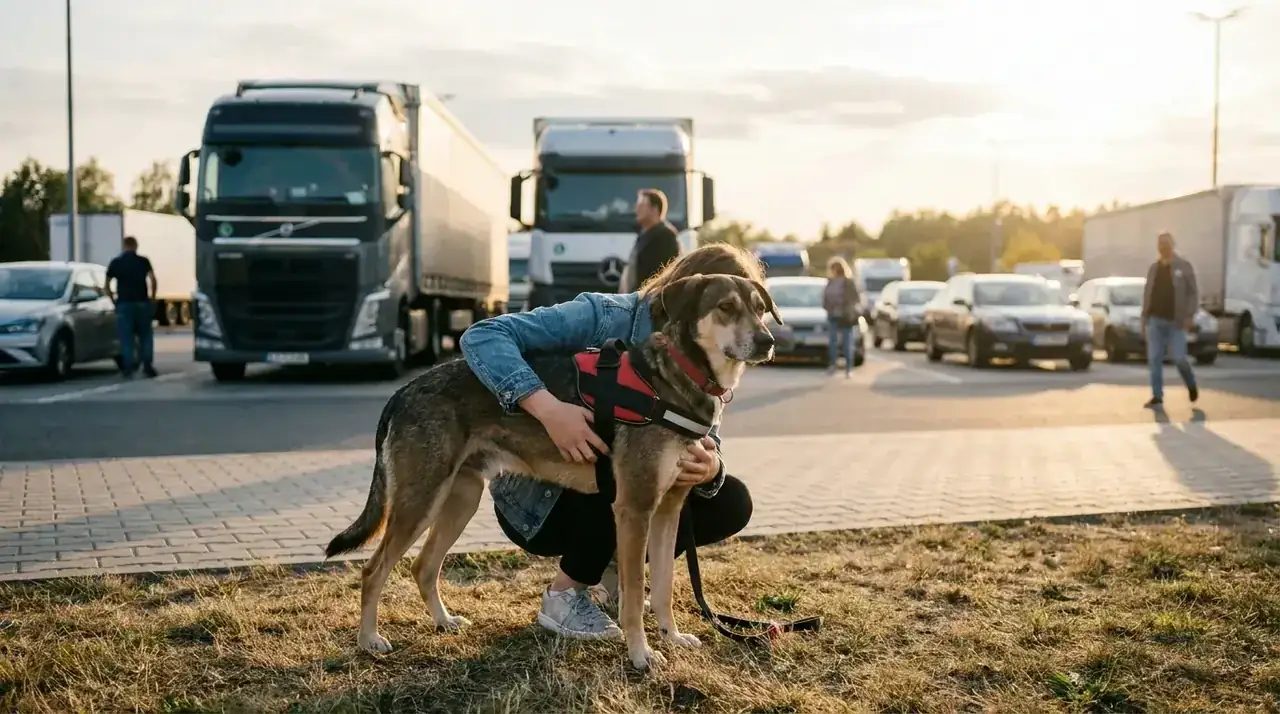
If your dog is a puller at highway rest stops, you already know the problem. You have four minutes, there are semis idling twenty feet away, two other dogs are losing their minds on the far side of the grass, and your dog has decided this particular strip of lawn is the most interesting place on earth. That is Roux on every single trip. She is a 42-lb border collie mix, and she has been through three harnesses that either slipped off her narrow chest, chafed her armpits, or gave me zero ability to redirect her when something caught her attention. The BARKBAY and the Ruffwear Front Range were my two finalists, and I tested both across a full driving season before picking a winner for travel use.
Short answer: the BARKBAY wins for road trips and rest stops. The Ruffwear Front Range is a genuinely good harness and I would still recommend it for dedicated hiking days when control is less critical and durability over miles of trail matters more. The use case is the deciding factor. Here is how I got there.
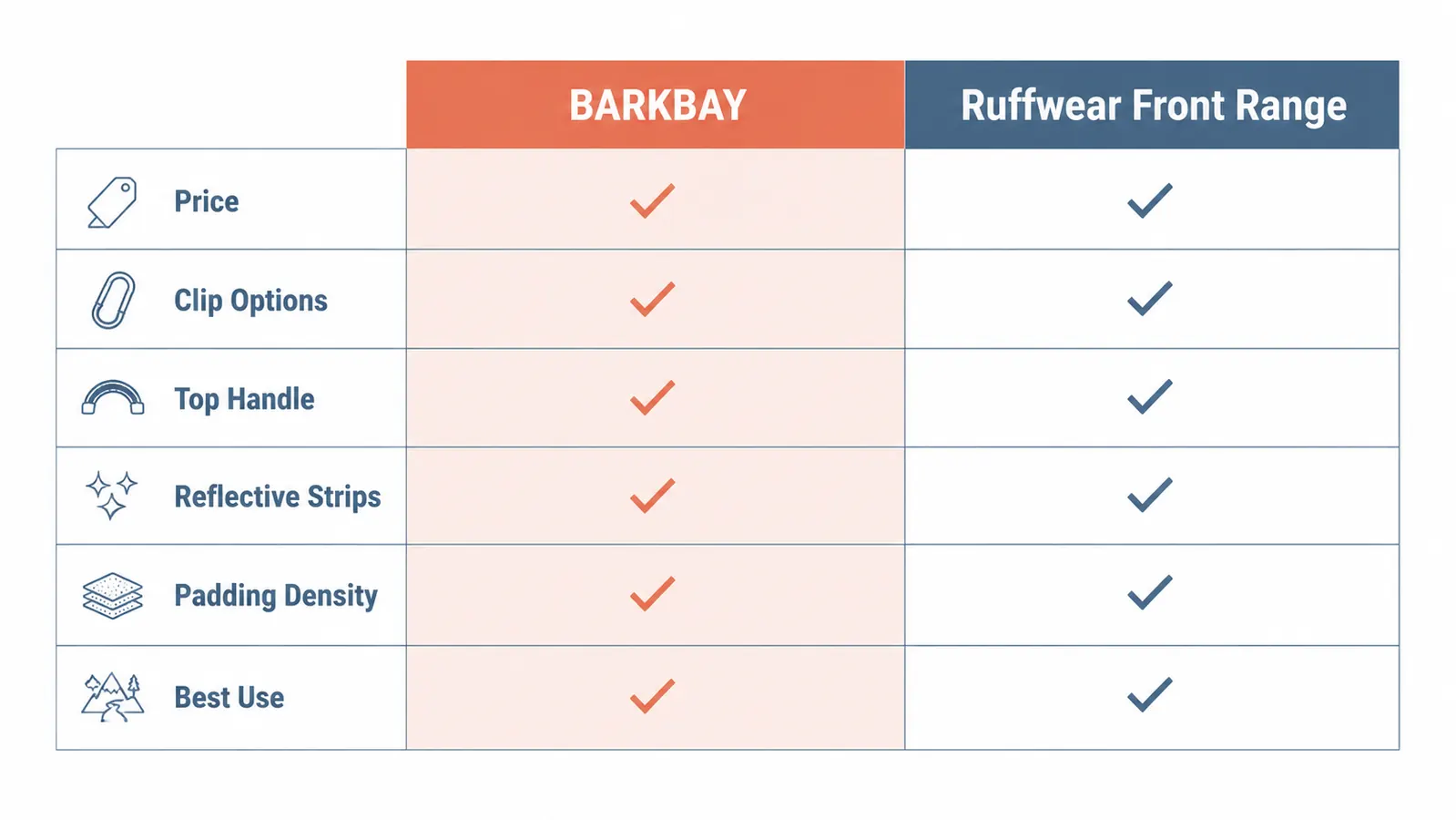
| Current Price | ~$27 (BARKBAY) | ~$65-70 (Ruffwear Front Range) |
| Front Clip (No-Pull) | Yes, chest D-ring | Technically yes, but positioned higher near sternum, less leverage on pullers |
| Back Clip | Yes, standard dorsal D-ring | Yes, dorsal D-ring |
| Top Handle | Yes, padded, easy to grip | No handle |
| Reflective Strips | Full-perimeter reflective bands on straps | Small reflective trim only |
| Padding Density | Thick chest and belly pad, good for barrel-chested builds | Lighter padding, better contouring for deep-chested dogs |
| Best Use Case | Travel, rest stops, urban walking, reactive or pulling dog | All-day trail hiking, calmer dogs, active outdoor adventures |
Roux has lunged at a semi truck at a rest stop. The BARKBAY front clip is the only reason I still have her.
If your dog pulls hard in high-stimulus environments, the front clip and top handle on the BARKBAY are not nice-to-haves. They are the whole point. Check today's price on Amazon.
Amazon Check Today's Price on Amazon →Where the BARKBAY Wins
The front clip on the BARKBAY sits low on the chest, which is what actually redirects a dog when she lunges. When Roux catches a scent and goes low and forward, clipping to the front means her momentum swings her back toward me instead of yanking my shoulder. The Ruffwear Front Range does have a front attachment point, but it sits higher toward the sternum and the geometry feels off for strong horizontal pullers. On Roux, it gave me maybe 60% of the correction the BARKBAY does.
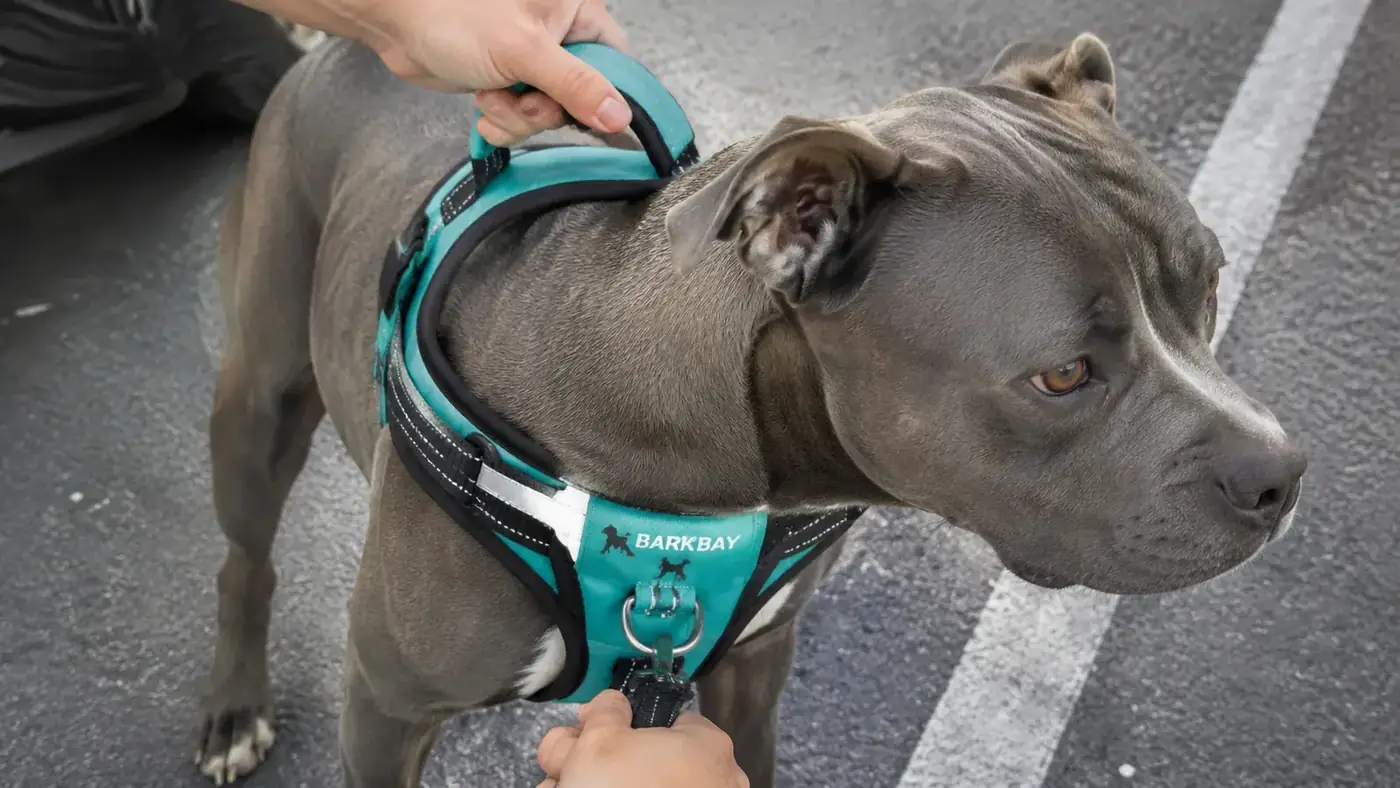
The top handle is the other thing that makes the BARKBAY the right harness for travel scenarios. At a rest stop when a dog materializes out of nowhere and Roux goes sideways, I can grab the handle and hold her in place while I get my footing. I use it to lift her into the truck after a swim, too. The Ruffwear Front Range has no handle at all. For a relaxed trail hike where your dog mostly walks beside you, that is fine. For the organized chaos of a crowded travel plaza at 2pm on a Friday, I want a handle.
Reflectivity matters more than most people think when you are walking dogs at dusk at a rest stop with vehicles moving nearby. The BARKBAY has reflective banding on nearly the full strap run, which means drivers and other pedestrians can see Roux clearly in headlights. The Ruffwear trims in reflective accents at the edges only. Both are better than nothing, but the BARKBAY is visibly brighter in low light.
Where the Ruffwear Front Range Wins
I want to be fair here because the Ruffwear Front Range is a genuinely well-made harness. The hardware feels more refined, the buckles have a satisfying click that the BARKBAY does not quite match, and the overall construction gives the impression it was built to last several seasons of daily trail use without complaint. The webbing is also slightly narrower and more contoured, which makes it a better fit for deep-chested dogs like a Weimaraner or a lean Vizsla where the BARKBAY's wider belly strap can feel like it is floating instead of fitting.
For long hiking days, the Ruffwear is the one I would pack. The lighter padding on the chest means less heat retention during extended exercise, and the fit system has more micro-adjustment range than the BARKBAY. Bear, my 9-year-old golden, wore the Front Range on a four-mile trail day in the Smokies and finished without any signs of rubbing at his armpits, which is where harnesses go wrong on big fluffy dogs first. For travel use where he mostly just walks from car to grass and back, the BARKBAY is sufficient and costs less than half the price.
The Ruffwear is a better hiking harness. The BARKBAY is a better travel harness. Those are two different products solving two different problems.
The Rest Stop Use Case: Why It Changes Everything
Most harness reviews are written by people who think about hiking. Trail performance, long-distance fit, pack attachment points. Those things matter if your dog hikes ten miles a week. But when you are a road-trip dog parent, the harness is doing something different. It is holding a dog still in a 10-foot strip of grass next to a diesel truck at a travel plaza, then getting that dog back into the vehicle before she drags you toward the vending machines. The design requirements are different: front clip for immediate correction, top handle for close-contact control, reflective banding for safety in parking lots at night or dusk.
The BARKBAY checks all three of those boxes. The Ruffwear Front Range checks one and a half. That is not a knock on Ruffwear. They built a trail harness and it works as a trail harness. They did not build a travel harness, and it shows when you try to use it that way.
Roux has been known to react to other dogs, motorcycles, diesel engines, and one particularly frightening stack of orange highway cones. In every one of those scenarios, the front clip and the grab handle on the BARKBAY have been what kept the situation from escalating into a real problem. I do not say this for dramatic effect. If you have a puller or a reactive dog and you are taking road trips, the hardware on a harness is a safety question, not a preference question.
Fit Notes for Barrel-Chested vs Deep-Chested Dogs
Roux is a deep-chested dog with a lean waist, and the BARKBAY's wide chest panel sits nicely on her without gapping. Bear is a barrel-chested golden with a broad, round rib cage, and the BARKBAY fits him well too because the chest pad is wide and the belly strap has enough room to sit flat without digging. Where the BARKBAY struggles is on truly narrow, deep-chested dogs like greyhounds or whippets. The wide panel can slide to the side on those builds, which undermines the front clip's effectiveness.
The Ruffwear Front Range, with its more contoured shaping and narrower chest piece, tends to fit narrow deep-chested dogs more cleanly. It is also the harness I would look at if your dog has unusually shallow chest clearance between the front legs, since the BARKBAY's belly strap can ride up on some short-legged or compact builds. These are edge cases, but worth knowing before you order a size and spend a week trying to make it fit right.
Price and the Honest Value Question
The BARKBAY is about $27 at today's price. The Ruffwear Front Range runs $65-70. That is not a small gap. I have replaced my BARKBAY once in two years of heavy travel use, so I am at $54 all-in versus what I would have spent on a single Ruffwear. The BARKBAY's buckles and stitching hold up well to repeated on-off cycles and rain, but I would not call it as durable as the Ruffwear over a multi-year horizon. The Ruffwear feels like it might outlast the BARKBAY two-to-one in terms of hardware longevity.
But here is the real question: what are you buying the harness for? If the answer is safety and control at rest stops plus everyday leash walks, the BARKBAY does that job well at a price that lets you replace it if it ever wears out. If you are a serious trail runner or hiker who needs a harness to survive several hours of rugged terrain per week, the Ruffwear's durability and fit quality justify the higher price. The mistake is buying the expensive outdoor harness for a use case that does not need it.
Pros
- Front clip sits low on the chest for real no-pull correction on strong lungers
- Padded top handle gives close-contact control in crowded spaces
- Full-perimeter reflective banding for rest stop visibility at dusk or night
- Wide chest panel fits barrel-chested and medium builds well
- Dual clip options let you use back clip for calmer walks and front for reactive moments
- Price is roughly one-third of comparable outdoor harnesses
Cons
- Wide belly strap can ride up on compact or very short-legged dogs
- Hardware feels less premium than the Ruffwear buckles on close inspection
- Not the best choice for deep-narrow-chested breeds where the chest panel gaps
- May need replacing after 1.5 to 2 years of heavy daily use
Who Should Buy the BARKBAY
You should buy the BARKBAY if you travel with your dog by car and spend a meaningful amount of time at rest stops, parking lots, trail parking areas, or any high-stimulus environment where a pulling or reactive dog needs to be managed quickly and confidently. It is also the right call if you have a medium to large dog in the 30-90 lb range with a barrel-chested or average build, if you walk your dog at night or in low-light conditions and want visibility, and if you want a capable harness without spending $65 on something you will be pulling on and off in truck stop bathrooms at 10pm.
Who Should Choose the Ruffwear Front Range Instead
Go with the Ruffwear if you are primarily a hiker or trail runner who brings your dog on long outings where comfort over hours of movement matters, if your dog is calm and relatively easy to manage on leash and the front clip is not a priority, or if your dog has a narrow deep-chested build that the BARKBAY does not fit cleanly. The Ruffwear is also worth the premium if you simply want a harness built to last five-plus years of daily use without showing wear. It is a quality product. It is just not solving the same travel problem the BARKBAY is.
The BARKBAY is the harness I reach for every time we get off the highway.
After a full driving season testing both harnesses on Roux at rest stops, trailheads, and parking lots across several states, the BARKBAY is the one that lives in the gear bag. Front clip, top handle, reflective banding. Check today's price on Amazon.
Amazon Check Today's Price on Amazon →