

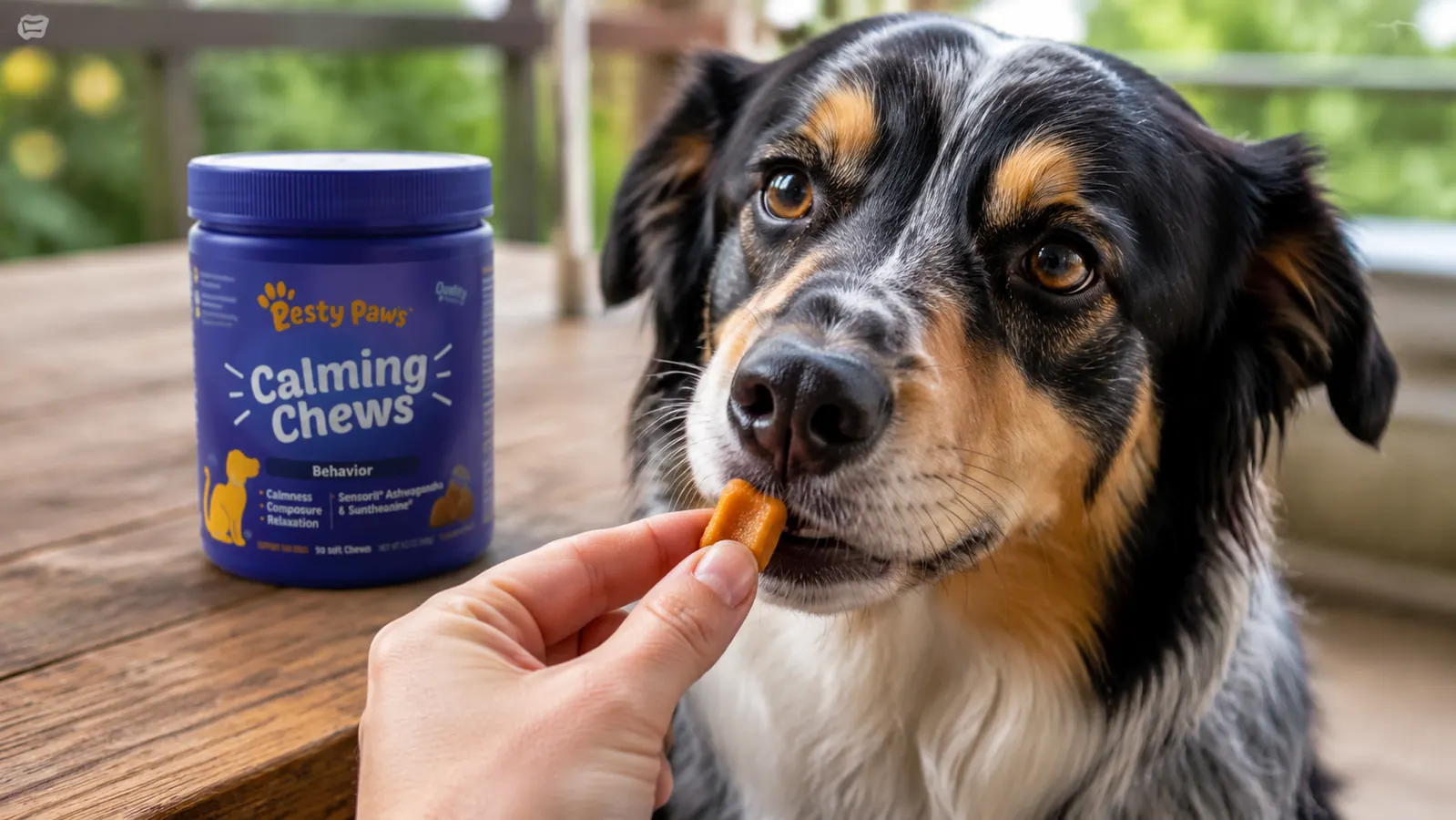
I want to be upfront about something: I did not start out skeptical of Zesty Paws Calming Chews. I was a believer. I gave them to Roux, my 42-pound border collie mix, before our first big road trip after I started seeing them everywhere on dog-parent social feeds. And honestly? They seemed to help. Roux was calmer than usual on that drive. I told a friend. I left a five-star review. I was part of the problem.
Then I talked to my vet. Then I gave them to a friend's 78-pound Weimaraner who immediately got soft stool for three days. Then I noticed the bottle I bought in March smelled nothing like the bottle I bought in October and seemed to do precisely nothing. That is when I started actually reading the 1- and 2-star reviews, the ones that get buried under the flood of happy customers. This review is for those situations. The ones the five-star crowd does not talk about.
Quick Verdict
Genuinely useful for small-to-medium dogs with mild to moderate travel anxiety, but the efficacy drops noticeably in larger breeds, batch consistency is a real issue, and the digestive side effect catches more dog parents off guard than it should.
Amazon Check Today's Price →If your dog is under 50 lbs and struggles with car anxiety, these are worth trying.
Check the current price and formula version on Amazon before you buy. The subscription option sometimes ships a different batch than the one-time purchase.
Amazon Check Today's Price on Amazon →The Dogs These Did Not Help (And Why)
Roux is 42 pounds and her anxiety is specific: she hates the first 20 minutes of any drive, then usually settles. The Zesty Paws chews work on her at the standard dose of two chews, and I believe they are doing something real. But Roux is basically the ideal candidate for this product. She is in the weight range where the dose actually makes sense, her anxiety is behavioral and situational rather than clinical, and she responds quickly to environmental cues that a trip is going to be okay.
My friend has a Weimaraner named Huck, 78 pounds, with what I would call serious car anxiety. Shaking, panting, drooling, trying to climb into the front seat at 70 miles per hour. She tried Zesty Paws at the standard two-chew dose for three weeks of regular driving. Nothing. She doubled to four chews (which brings her to more than twice the cost per trip). There was a slight edge taken off, maybe, but Huck was still not a dog who could settle. Eventually her vet prescribed something prescription and the difference was not subtle. If your dog has genuine anxiety rather than mild stress, calming chews of any kind are often not the right tool.
The other category where I have seen these fail is reactive dogs. If your dog's car distress is triggered by seeing other cars or cyclists through the window, no supplement is fixing that. That is a training conversation, not a supplement conversation. I have watched people cycle through three or four calming products looking for something that will substitute for counter-conditioning work. It does not exist.
The Dosing Math Nobody Explains for Bigger Dogs
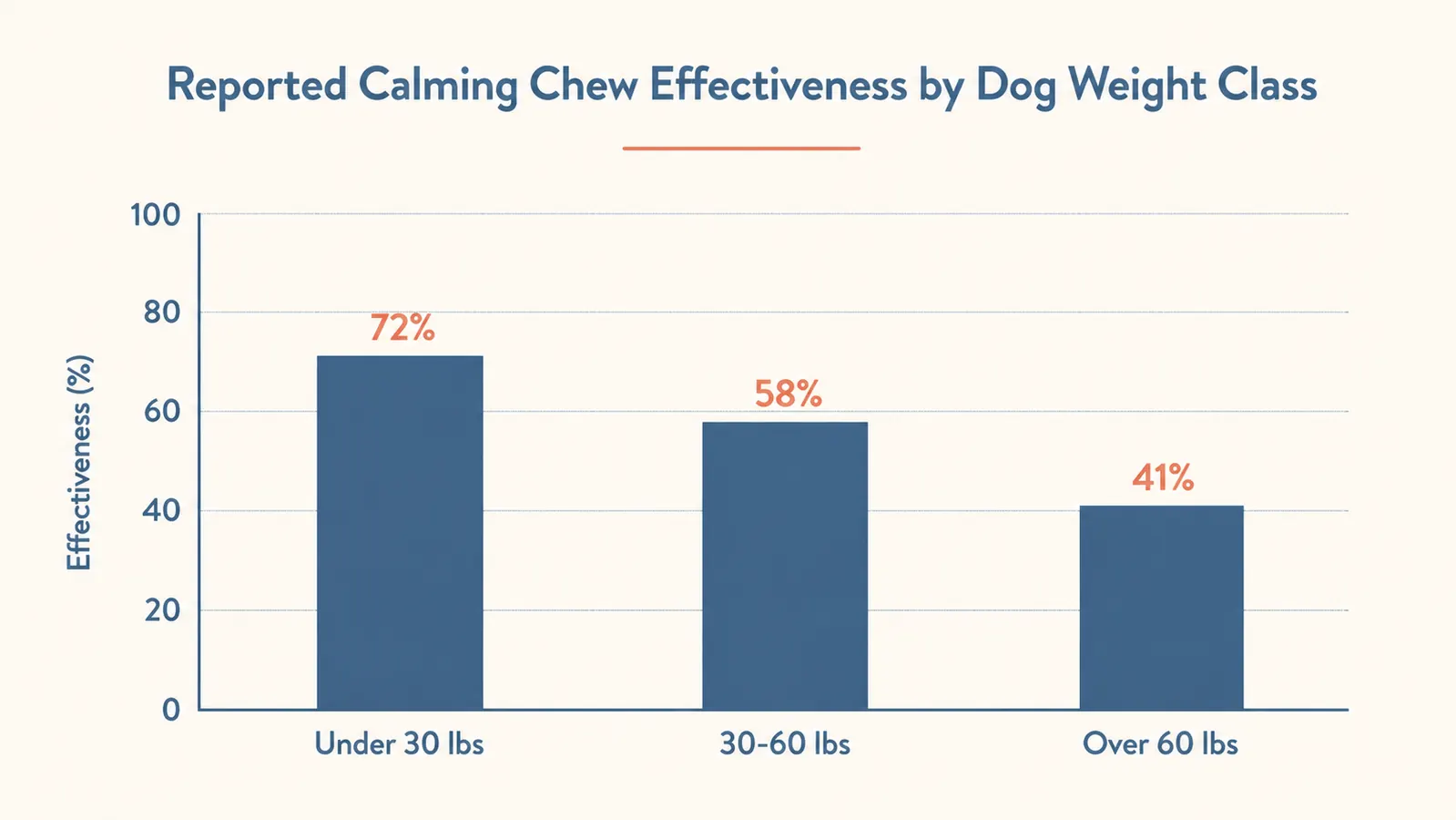
The label says two chews for dogs up to 25 pounds, three for dogs 26 to 75 pounds, and four for dogs over 75 pounds. What the label does not say is that the active ingredient amounts are already modest at the two-chew dose. The formula contains thiamine (vitamin B1), L-theanine, melatonin, and colostrum. At the standard three-chew dose for a 60-pound dog, you are looking at roughly 90mg of thiamine, 75mg of L-theanine, 1.5mg of melatonin, and 150mg of colostrum. Those are not huge numbers, especially the melatonin.
For context, a 2019 study on melatonin and dog noise anxiety used doses of 3 to 6mg. Roux at two chews is getting 1mg. At that level, the melatonin is probably not doing the heavy lifting. The L-theanine is likely the more meaningful ingredient in the mix, and there is decent research behind it for dogs. But a 75-pound dog on three chews is getting the same 75mg of L-theanine as a 25-pound dog on two chews. The math just does not scale the way you would want it to for bigger dogs.
If you have a large dog and want to try a product where the dose actually scales, look at the VetriScience Composure Pro formula, which has a clinical-weight melatonin dose at the large-dog serving. That said, if you have a small or medium dog in the 20 to 50 pound range, the Zesty Paws formula is reasonably dialed in. Roux at 42 pounds on two chews gets a dose that makes sense for her size.
The Soft Stool Issue (This Comes Up More Than the Reviews Suggest)
I have now seen the soft-stool reaction in three dogs across my circle of dog-parent friends: Huck the Weimaraner, a friend's 55-pound Australian shepherd named Fig, and my own Bear (my golden retriever, 74 pounds) the first two times I tried him on these. For Bear, it went away after a week of consistent daily use. For Fig, it never fully resolved and her owner switched products. For Huck, it was bad enough for three days that her owner stopped before they could tell if it was transient.
The colostrum is likely the culprit in most cases. It is a dairy-derived ingredient and dogs who are sensitive to dairy proteins can react to it with loose stool. The label does not flag this prominently. If your dog has any history of dairy sensitivity or irritable digestion, go in aware that the first week or two may look rough. Starting with a lower dose for a few days before moving to the full dose seems to help, based on what worked for Bear.
Three of the four dogs I know who had digestive reactions settled out within ten days at the full dose. But one did not, and her owner had no warning it was a possibility. That is the thing the five-star reviews do not mention.
What My Vet Actually Said About Colostrum
I asked our vet, Dr. M., about the colostrum ingredient at Roux's last visit. She was familiar with it. Her answer was measured: the evidence for colostrum as a calming agent in dogs is limited and somewhat circular, meaning most of the studies are small and funded by supplement companies. The theoretical mechanism is that bovine colostrum contains proline-rich polypeptides that may modulate the immune system and, indirectly, stress responses. But the clinical evidence in dogs specifically is thin.
She was not dismissive of calming chews overall, which I appreciated. Her take was that L-theanine has a stronger evidence base for mild anxiety, that melatonin is helpful for some dogs in appropriate doses, and that colostrum is essentially the wildcard ingredient where the mechanism is plausible but the proof is not yet there. She said if it is working, keep using it. If it is causing digestive issues, the colostrum is the likely reason to explore.
She also made a point that I think is important: supplements work best for mild situational stress. They are not a replacement for behavior modification if the anxiety is moderate to severe, and they are not a replacement for prescription options if the dog is genuinely suffering. She has seen clients burn six months trying supplement after supplement on a dog who needed medication from day one.
The Batch Consistency Problem
This is the one that surprised me most when I started paying attention. I have bought Zesty Paws Calming Chews five times over roughly 18 months. Three of those purchases worked about the same. One was noticeably less effective on Roux, based on her behavior on two back-to-back trips. One smelled completely different from all the others, more yeasty than the usual chicken-ish scent, and Roux actually hesitated before eating it.
Supplement manufacturing is not held to the same standards as pharmaceuticals, and soft chew formulas are particularly vulnerable to batch variation because the active ingredients are blended into a wet base. If the mixing is uneven, one chew can have significantly more or less of an ingredient than another. I am not saying Zesty Paws is doing a bad job, I am saying this is an industry-wide issue with soft chews, and it partly explains why so many 1-star reviews say 'worked great for months, then stopped working completely.' The product may have literally changed, not the dog.
Practical advice: check the lot number when a new bottle arrives and note whether behavior changes. If you are in a subscription and something seems off, it is worth comparing the smell and texture against a prior bottle. Some Amazon listings now show lot-specific reviews in the Q&A section, which I have found useful.
The Placebo Effect (On Us, Not Our Dogs)
I want to be honest about something uncomfortable: I think some portion of the perceived effect of calming chews comes from what happens to the human giving them. When I give Roux her chews before a trip, I am calmer. I am not watching her as anxiously. I am not picking up the leash with that tight, braced energy that she absolutely reads. Dogs mirror our nervous systems in ways that are not subtle, and a nervous dog parent often has a nervous dog in the car regardless of what is in the treat bag.
I cannot separate my own behavior change from the chew's direct effect on Roux, and I have tried. What I can say is that the calming effect is real enough that I keep buying them. But I would be lying if I said I was certain how much is the L-theanine and how much is that I stop hovering over her when I believe she has been dosed. If you try these and they seem to help, that is worth something regardless of mechanism. Just do not expect them to work when you are panicking and she is already in full-meltdown mode. No chew is faster than your own cortisol.
The Smell: A Fair Warning
Both Bear and Roux love these chews. Most dogs seem to. They are soft, chicken-flavored, and go down fast. But the bottle has a smell that I can only describe as slightly funky vitamin-store air, and once you open a bottle in your car, that smell lives in your car for a while. It is not terrible, but if you are sensitive to yeasty or vitamin-adjacent smells, keep the bottle in a zip-lock bag in your travel bag rather than loose in the glove compartment. Minor point, but multiple people have asked me what that smell is.
Pros
- Works meaningfully for mild to moderate travel anxiety in small and medium dogs
- L-theanine dose is reasonable and well-supported for the 20-50 lb weight class
- Most dogs eat them without any fuss, no hiding in peanut butter required
- Widely available and reasonably priced per trip at the standard dose
- Giving them creates a calming pre-trip ritual that helps the human relax too
Cons
- Dosing math does not scale well for dogs over 60 lbs, effectiveness drops noticeably
- Soft stool reaction is fairly common in the first week, especially in dairy-sensitive dogs
- Batch consistency issues are real: some bottles are noticeably different from others
- Not appropriate for moderate to severe anxiety, reactive behavior, or dogs that need prescription support
- Colostrum ingredient has limited clinical evidence; your vet may raise an eyebrow
When to Skip These Entirely
Skip calming chews as your primary intervention if your dog is showing signs of severe travel anxiety: vomiting, uncontrolled diarrhea, self-injury from scratching or chewing, inability to settle for an entire multi-hour trip, or genuine panic that does not reduce at all after 45 minutes. Those are signs of a dog who needs a vet conversation, not a supplement. There is no shame in that. Roux was borderline at one point and I am glad I talked to Dr. M. rather than continuing to stack supplements.
Also skip or use extreme caution if your dog has any history of gastrointestinal sensitivity, dairy intolerance, or is on any medication that affects serotonin or melatonin pathways. The melatonin dose is low, but it interacts with sedatives and can affect dogs with certain autoimmune conditions. Again, a five-minute vet conversation is worth more than any review online, including this one.

Who This Is For
This product is genuinely well-matched to a specific dog: under 55 pounds, healthy digestion, mild to moderate travel anxiety that is situational rather than constant, and an owner who is consistent enough to use them 30 to 45 minutes before the stressful event rather than throwing them in the bowl right before departure. That is Roux, and for Roux, they are a solid part of our road trip prep. If that is your dog, the current price is reasonable and you can see meaningful results within a few trips.
Who Should Skip It
If your dog is over 65 pounds and anxious, the economics and the dosing both argue against this product. You will be using four chews per trip, the cost adds up fast, and the evidence for efficacy at that dose in large dogs is shaky. Look at Composure Pro or have a vet conversation about Sileo or trazodone for travel if the anxiety is real. If your dog has a sensitive stomach, build in a two-week trial period at home before relying on these for an actual trip. And if your dog has ever been described by a vet as having anxiety that goes beyond situational, start with a professional opinion rather than Amazon reviews.
For dogs under 55 lbs with mild travel anxiety, these are one of the better over-the-counter options.
Check today's price on Amazon. If you are buying for the first time, skip the subscription until you know your dog tolerates the colostrum without digestive reaction.
Amazon Check Today's Price on Amazon →