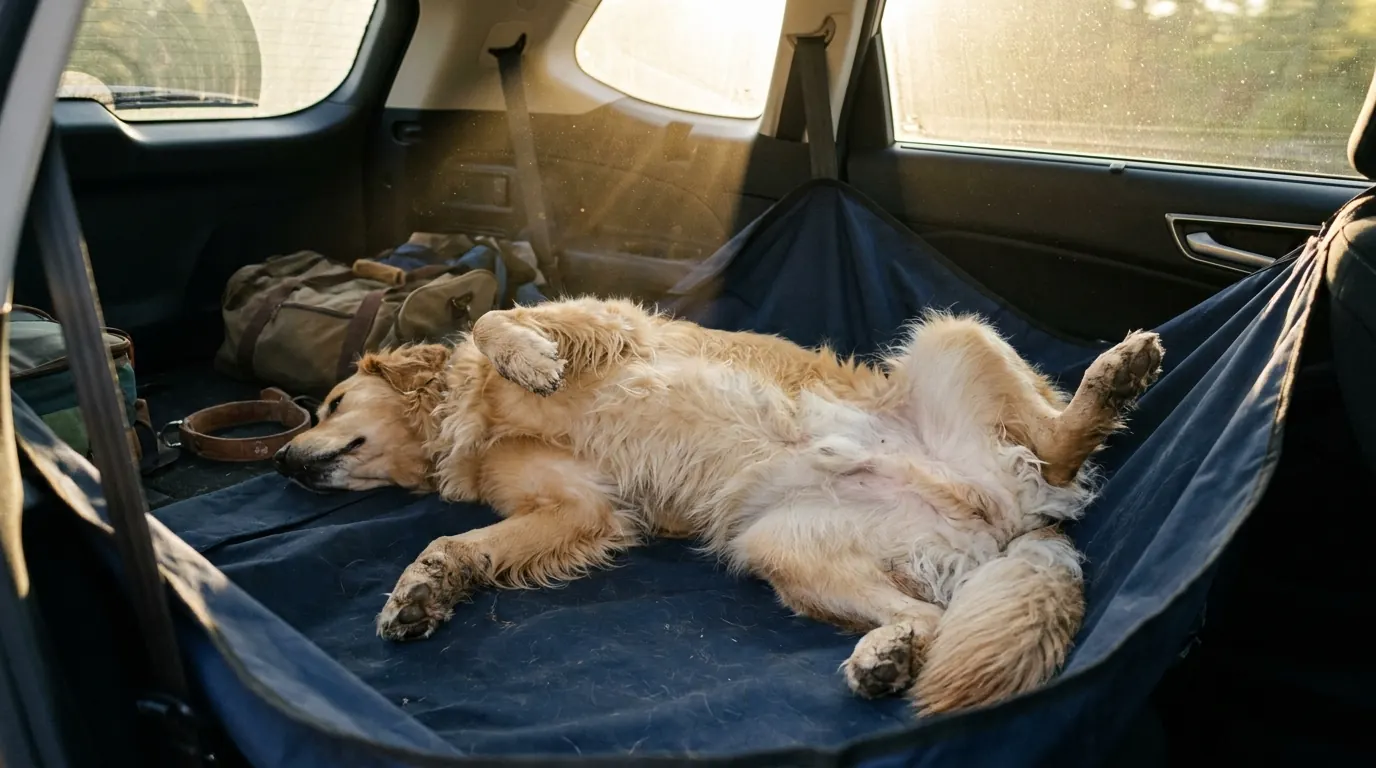
By the time we finished the Colorado trip last October, I had a truck backseat that looked like a mudroom floor. Bear, my nine-year-old golden retriever, had shaken off an entire creek's worth of water somewhere near Salida. Roux, my 42-pound border collie mix, had spent twenty minutes digging in a red-dirt pullout before I could stop her. Both dogs then climbed back into the truck and settled in for a four-hour drive home. That was the moment I decided to stop pretending that a pile of old beach towels was a real system.
I ordered the Active Pets Waterproof Hammock Seat Cover that night. Over the next twelve months, it went on trips to the Gunnison Gorge, a camping week in the Ozarks, three overnight drives on the I-70 corridor, and enough weekend hikes that I stopped counting. I have now washed it fourteen times. Here is everything I learned.
Quick Verdict
Solid waterproofing, excellent footwell barrier, and genuinely easy washing, but the side-wall anchor straps started fraying at month nine and it adds real visual bulk to the interior.
Amazon Check Today's Price →Your upholstery is losing every time two wet dogs climb in without this.
The Active Pets hammock has over 20,000 reviews. It covers your seats, closes off the footwells, and machine-washes clean. See the current price on Amazon before your next road trip.
Amazon Check Today's Price on Amazon →How I Have Used It
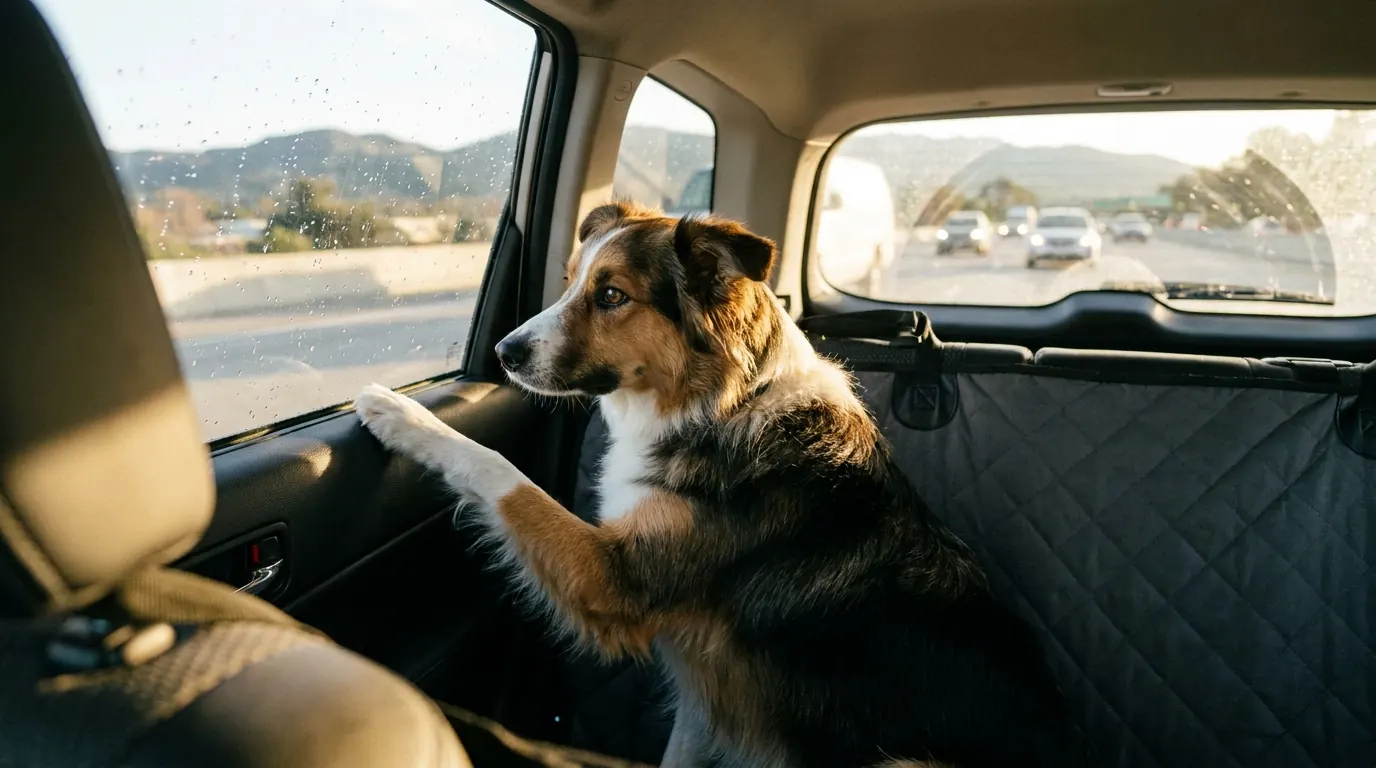
The cover went into my 2019 Ford Explorer, which has a standard 60/40 split rear bench. I am calling this out because the Active Pets hammock fits very differently in an SUV than in a sedan. In the Explorer, the fabric sits with some slack across the seat cushion, which the dogs actually liked. The hammock geometry meant they were slightly cradled rather than perched on a flat surface, and Bear especially stopped sliding around on corners after the first trip. I tried it once in my friend's Camry and found it much tighter, with the headrest straps pulling forward at an uncomfortable angle. Not a dealbreaker in a sedan, but worth knowing if you have a lower roofline.
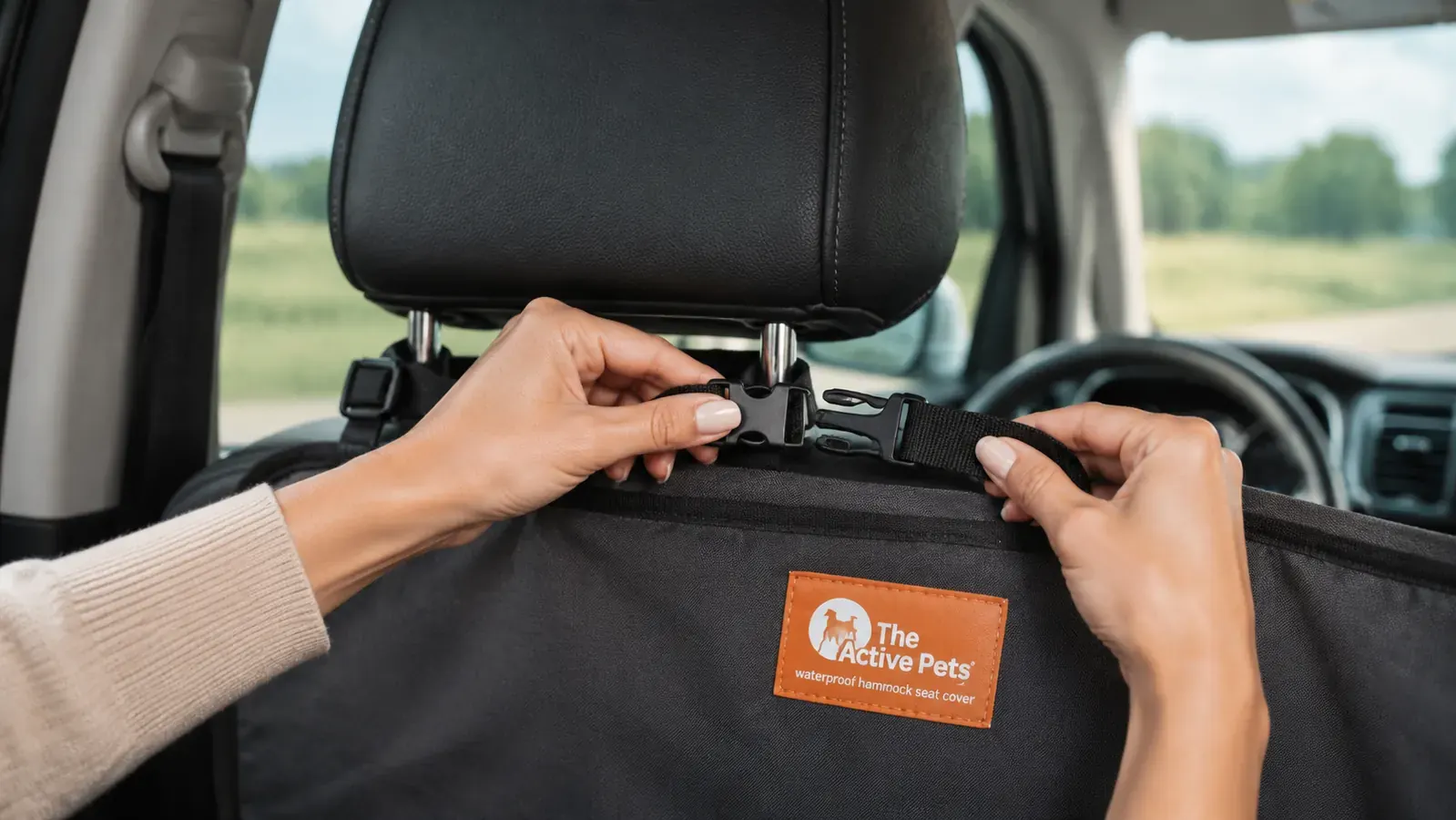
My standard install routine took about four minutes once I knew what I was doing. You loop two straps over the front headrests, two straps over the rear headrests, and clip one seat-anchor strap through the seat crack between the cushions. That seat-anchor strap is the part I want to talk about honestly, because it is the most important feature and also the most fiddly. More on that below.
On a typical weekend trip I install it Friday evening before packing the car, and uninstall it Sunday night after the dogs are settled. For longer road trips I leave it in for the full run. The longest continuous stretch was six days through Missouri and Arkansas, and the cover came out looking like it needed a wash but not like it had failed.
The Hammock Side Walls: The Feature Nobody Talks About Enough
When I was using towels, Roux would inevitably end up wedged half-off the seat with one leg dangling into the footwell behind the passenger seat. She never seemed to mind, but it made me nervous on highway stretches, and it definitely made my leg uncomfortable when she used the footwell as a stepping stone to rearrange herself at 70 mph. The hammock design solves this in a way I did not fully appreciate until I watched Roux try to fall off the seat for the first time after the cover was installed.
The fabric panels that hang down from the seat edge and attach to the base of the seat form a soft wall on each side. They are not rigid, so a dog could push through them if they really wanted to, but in practice both of my dogs seem to feel the barrier and stop. Roux has not landed in the footwell in twelve months. Bear, who weighs around 88 pounds as of his last vet visit, occasionally leans heavily into the panel on his side, and it holds without pulling the seat strap loose. That specific detail, stopping a large dog from spilling into the footwell during a sudden stop, is worth every dollar of the cover price by itself.
Waterproofing: What a Year of Wet Dogs Actually Does to It
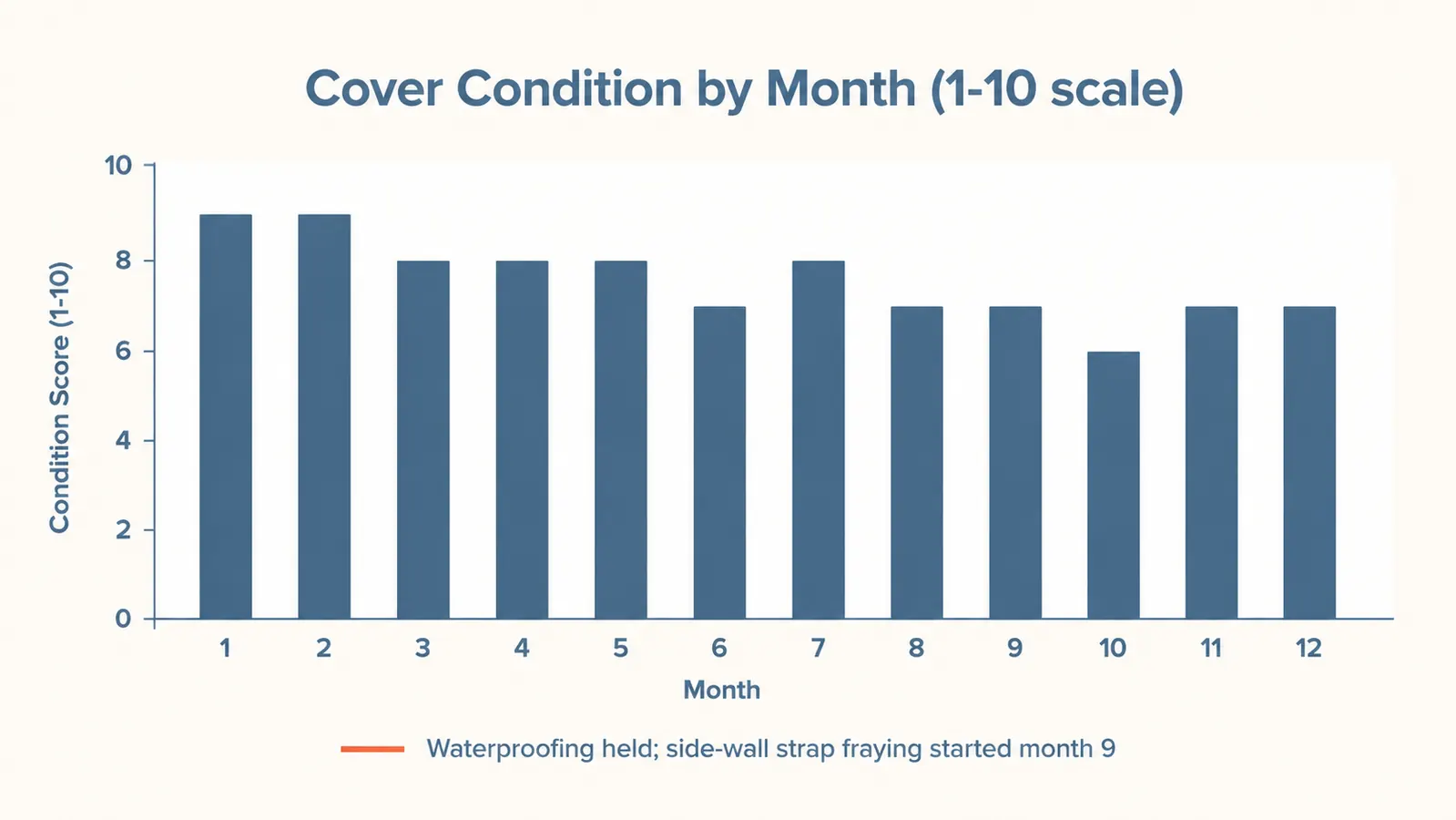
Active Pets describes the fabric as 600D Oxford cloth with a waterproof lining. After fourteen washes and twelve months of use, I can say the waterproofing is real but not invincible. For the first eight months, water and wet-dog moisture beaded off the surface the way it should. When Bear shook off after a river crossing in August, the seat underneath was completely dry. I checked.
By month ten, I noticed the center section, where Bear lies most of the time, had started to absorb moisture more slowly instead of repelling it immediately. It still protected the seat, but the fabric held dampness longer before drying. This is a normal result of abrasion and repeated washing degrading the DWR coating over time. It was not a failure; it was just wear. If you want to restore performance, a can of Nikwax fabric waterproofer fixed it completely after one treatment. I should have done this sooner and I am now doing it every four or five washes.
What impressed me more was how clean the cover washed. After the Ozarks trip, the cover had a combination of red clay mud, dried grass seeds, and what I am fairly confident was fish smell from a bait store parking lot where Bear investigated a trash can. I shook it out in the driveway, ran it through a cold gentle cycle in my front-loader, and hung it outside. It came out completely clean with no residual smell. The stitching held on every wash. No seam separation, no backing delamination. Fourteen washes is not a lifetime, but it suggests this cover is built to be washed regularly rather than babied.
Install and Uninstall Friction: The Honest Version
The marketing makes installation look effortless. It is not hard, but it takes longer than the photos suggest, especially the first dozen times. The front headrest straps go on fast. The rear headrest straps require you to thread the webbing through the gap between the headrest post and the seat, which is fine in a car with adjustable headrests and annoying in a car where the rear headrests are fixed stubs. My Explorer has adjustable rears, so I slide them up, thread the strap, and slide them back down. That part takes maybe ninety seconds.
The seat-anchor strap is the real friction point. You push a flat strap down into the gap between the rear cushion and the seat back, and it is supposed to anchor the cover so the center panel stays taut rather than bunching. In my Explorer the gap is narrow enough that I have to work the strap in with two fingers, and on cold mornings when the seat cushion is stiffer, it takes a minute of wiggling. Once it is in, it holds well. Pulling it out at the end of a trip is the same process in reverse. I have watched my husband do the install and he finds it more annoying than I do, which I think is a hand-size issue.
The total install time for me is now about four minutes. The first trip it took closer to twelve. That learning curve is real and worth mentioning, because a few people I know gave up on similar hammock covers after struggling with the straps the first time and assuming the product was broken. It is not broken. It just takes practice.
The Bulk Problem: What It Does to Your Interior Aesthetics
I am going to be honest here because this is something I thought about giving up over. The Active Pets hammock cover is not subtle. It is a large panel of dark navy fabric draped over your backseat with visible straps running up to the headrests. It changes the look of your interior completely. If you share your truck with a partner who does not love the dog-travel aesthetic, expect to have a conversation.
The bulk also matters practically. With the cover in place, the rear seat looks shorter from floor to ceiling because the fabric cuts across the lower portion of the seatback. Adult passengers sitting in the rear seats can still sit comfortably, but they will notice the extra fabric under them, and the footwell panels are in the way if someone needs to put their feet flat on the floor. I remove the cover any time I have rear-seat passengers who are not dogs. That is a four-minute task, so it is not a big deal, but it does mean the cover is not a set-it-and-forget-it install if you regularly carry people back there.
The alternative to this cover was buying new upholstery. Or a new truck. The cover wins by a wide margin even if it is not pretty.
What Wore Out First
At month nine, I noticed the side-wall anchor straps, the ones that attach the hanging panels to the base of the seat, had started to fray where the webbing passes through the buckle. They have not failed, but they look rough and I expect to replace them before the second full year. This is the single structural weakness I found. The main cover fabric, the headrest straps, and the seat-anchor strap all look fine. Just those two side-wall anchors on each side. Active Pets customer service sent me replacement straps at no charge when I emailed photos, which I appreciated. Good to know the support exists.
The zippers on the side openings, which let you fold back the door panels so the dogs can get out without uninstalling the whole cover, have stayed smooth throughout. I use them constantly. Bear and Roux both know to wait at those openings now, which has made every rest stop exit dramatically calmer than it used to be.
Pros
- Hammock side walls genuinely prevent large dogs from falling into the footwell at highway speeds
- Waterproofing held well for the first eight to nine months before needing a DWR refresh
- Machine-washes cleanly after genuine trail and river use, including heavy mud and wet dog smell
- Side zipper panels let dogs exit without a full uninstall, which saves time at every stop
- Active Pets replaced fraying anchor straps without hassle after an email with photos
Cons
- Seat-anchor strap is fiddly to thread through tight seat gaps, especially on cold mornings
- Adds significant visual bulk to the interior, not appropriate when rear passengers are expected
- Side-wall anchor strap webbing showed fraying at the buckle by month nine under heavy use
- Waterproof coating needs DWR refresher treatment after extended use and repeated washing
- Fit in sedans with low rooflines puts uncomfortable tension on the front headrest straps
How It Compares to What I Used Before
Before the Active Pets cover I cycled through three solutions. First was a pile of beach towels, which shifted constantly, left exposed seat edges, and required me to do laundry every time we got home. Second was a cheap flat seat cover from a big-box store that had no hammock feature and no side walls, which meant the dogs still slid around and Bear still ended up with his hindquarters half-off the seat on corners. Third was a higher-priced hammock I tried for one trip that installed beautifully but whose waterproofing failed after a single river outing, leaving a permanent wet-dog smell in the fabric.
The Active Pets hit a balance those three options missed. It installs better than the cheap flat cover, washes better than the expensive one, and stops the sliding problem that towels never addressed. If you want a detailed side-by-side comparison with a premium option, I wrote up my notes from testing both covers on the same backseat in the Active Pets vs Plush Paws comparison. The short version: the premium cover has nicer fabric and a simpler seat anchor, but for most dog travel use cases the Active Pets gets you 90 percent of the protection at half the price.
Who This Is For
This cover is the right call if you have one or two medium-to-large dogs, drive an SUV or crossover, and do real outdoor trips where the dogs come back genuinely dirty. It is especially right if you have a dog who leans on the seat edge or has slid off the seat before, because the hammock geometry and side panels solve that problem reliably. It also makes sense if you want something you can wash regularly without worrying about ruining it. The Active Pets is built to be a working piece of gear, not a showroom cover.
It also fits well into a broader car-cleanliness system. I pair it with a door-edge protector and a trunk liner, and together those three things mean I can take the dogs on a two-week road trip and have the truck looking reasonable when I get back. For more on the full system, see my notes on keeping the car clean with dogs on road trips.
Who Should Skip It
If you drive a compact sedan with fixed rear headrests and a low roofline, this cover is going to fight you every time you install it. The geometry assumes a certain amount of vertical clearance between the rear headrests and the front seat tops, and sedans sometimes do not have it. Try a flat bench cover with side barriers instead.
If you carry rear-seat passengers frequently and want to avoid a four-minute install every time, look for a cover that can convert between hammock and flat mode more easily. The Active Pets does not convert quickly. It is either fully installed or fully out. If you need a middle ground for a family with both kids and dogs sharing the backseat on long trips, a split-panel design will serve you better.
And if you have a tiny dog who mostly naps in one spot and never gets wet, honestly, a good washable throw blanket will do the job and cost you a third of the price. The hammock's value comes from its containment geometry. If containment is not your problem, you do not need hammock geometry.
A year of mud, river water, and golden retriever fur, and the seat underneath is still clean.
The Active Pets hammock has 20,854 reviews and a price that makes the decision easy. If your backseat has seen one too many wet dog shakeouts, check the current price on Amazon and have it installed before your next trip.
Amazon Check Today's Price on Amazon →