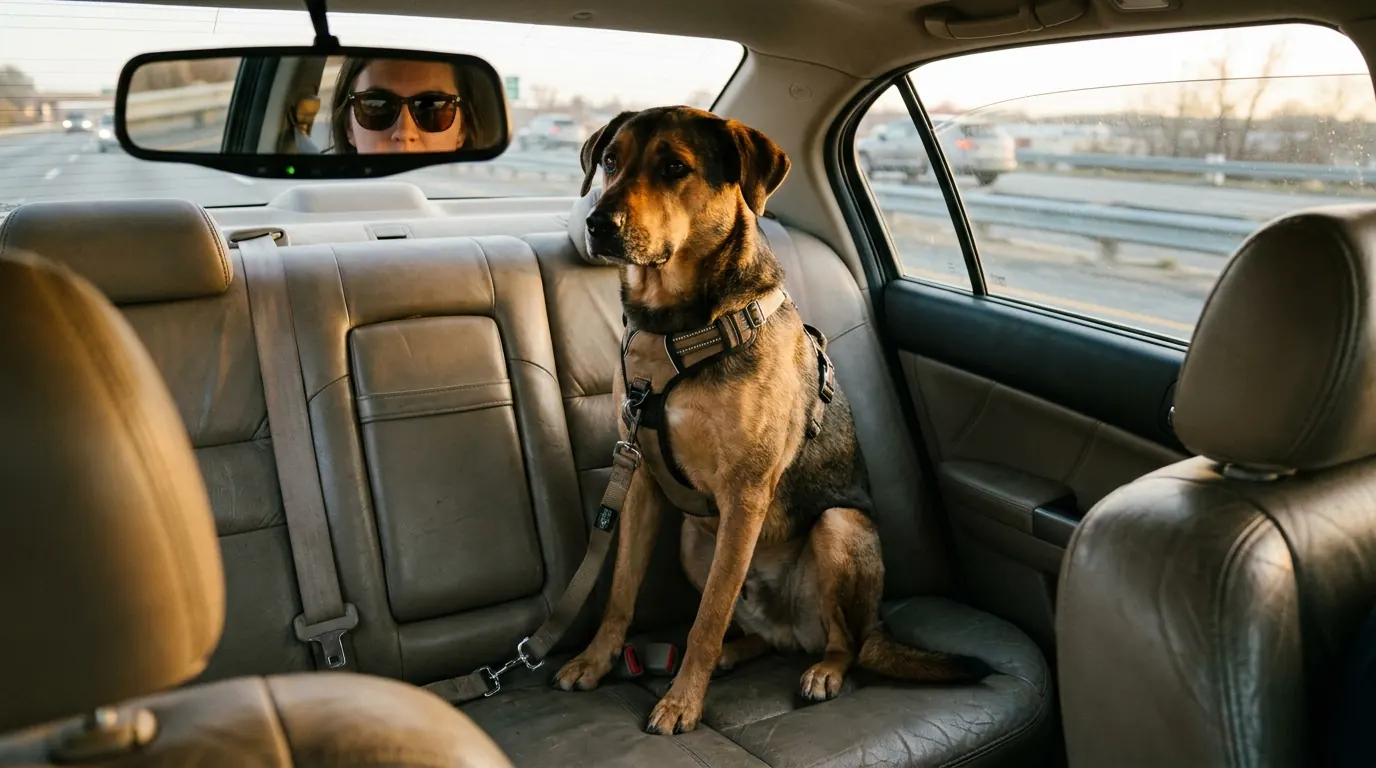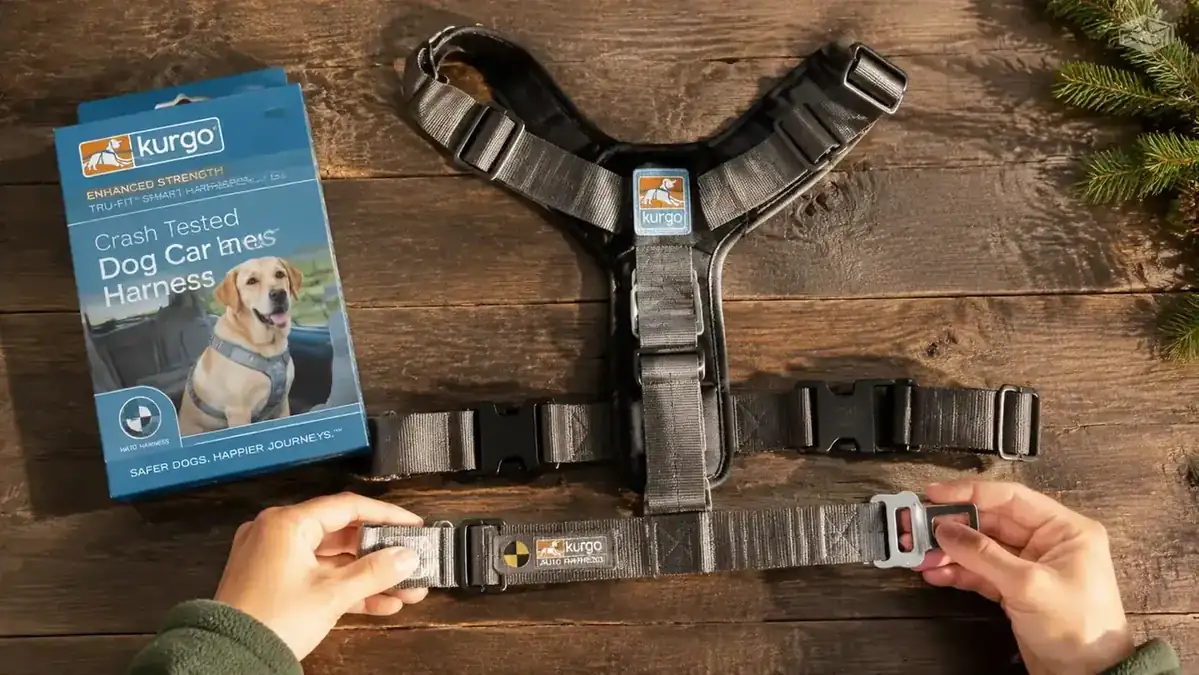
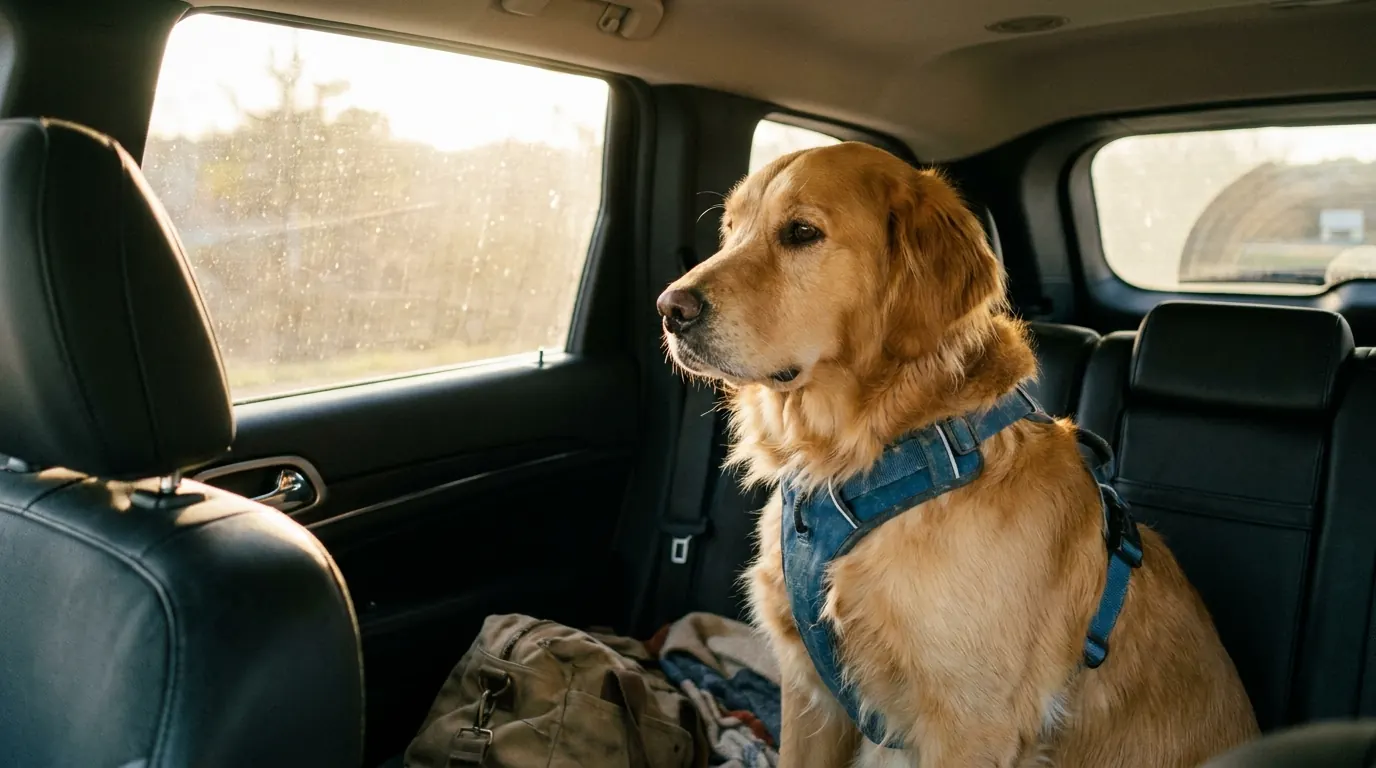
I bought the Kurgo Tru-Fit for Bear about 14 months ago. Bear is my 73-pound golden retriever, and I bought a Large based on his neck and chest measurements, which put him squarely in Kurgo's size chart. The harness arrived, I put it on him, took a photo because he looked very official, and drove to New Mexico feeling like I had finally solved the car-safety problem. That was the easy part of this story.
About three months in, I noticed something I had been ignoring: Bear had a small pink rubbed spot just behind his left foreleg where the belly strap crosses. Nothing serious. But it was there every time I took the harness off after a drive longer than two hours. I had also started to notice that the chest plate sits noticeably lower on his body than it does on the dogs in Kurgo's product photos, and that one of the side adjustment buckles had a habit of loosening itself by about half an inch on the first big bump or freeway transition. This review is about those things, not the crash-test certificate. The certificate is real. Kurgo did pass the Center for Pet Safety testing. But the certificate tells you what the harness does in a controlled sled test. It does not tell you what happens to the fit over a four-hour drive through Colorado.
Quick Verdict
Genuinely safe for most dogs in most cars, but the fit system rewards obsessive re-checking and is not forgiving on dogs with non-standard torso proportions.
Amazon Check Today's Price →If your dog rides unsecured right now, even a loose-fitting Tru-Fit is safer than nothing.
The Kurgo Tru-Fit is crash-tested and currently the most affordable certified harness on Amazon. If the fit issues I describe do not apply to your dog's build, it is a strong buy. Check the current price and see the size chart before you order.
Amazon Check Today's Price on Amazon →How I Actually Used It (and When the Problems Showed Up)
For the first two months, I had no complaints worth writing down. Bear sat in the back seat, the harness clipped to the center seat belt buckle using the included loop, and everything felt tight and purposeful. I ran him through a few abrupt braking tests in empty parking lots. He rocked forward, the harness caught, and he settled back. That part works. The seatbelt loop is steel-reinforced and there is nothing budget about it.
Month three is when I started noticing the belly strap thing. On shorter drives under 90 minutes, nothing showed. On the longer hauls, specifically anything over two and a half hours, Bear would come out of the harness and I would find that faint pink stripe behind his foreleg. I tightened the belly strap by one notch. Then two. At two notches tighter than what his measurements recommended, the rubbing stopped but his movement was visibly restricted in a way I was not happy with. For what it is worth: Bear has a deep retriever chest and a relatively short torso. His barrel ribcage is proportionally wider than it is long. The Tru-Fit design assumes a certain torso length that dogs like him do not have. If your dog is long-bodied, a hound or a lab mix with a leaner build, you will probably never see this.
I also brought Roux, my younger shepherd mix at 48 pounds, into the testing. She is the opposite body type: narrower chest, longer back, lean. On her the harness sat beautifully. No rubbing. No movement complaints. Her size Medium Tru-Fit fits like it was designed for her specifically, because it probably was. The size chart is built around proportions that match dogs like Roux far better than dogs like Bear. Keep that in mind when you read the five-star reviews. A lot of them are written by people with long-bodied medium dogs.
The Fit Buckle Problem Nobody Warns You About
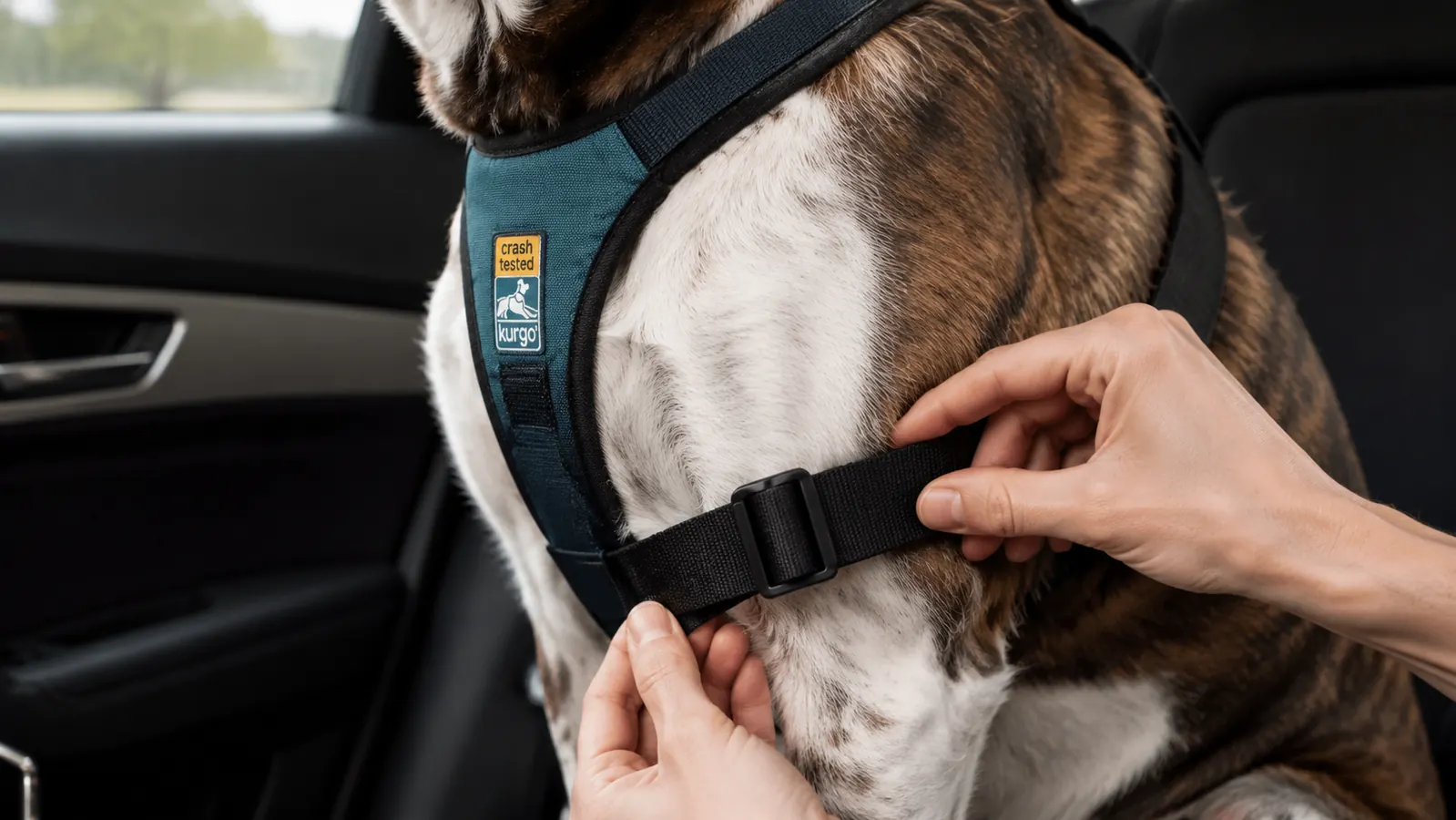
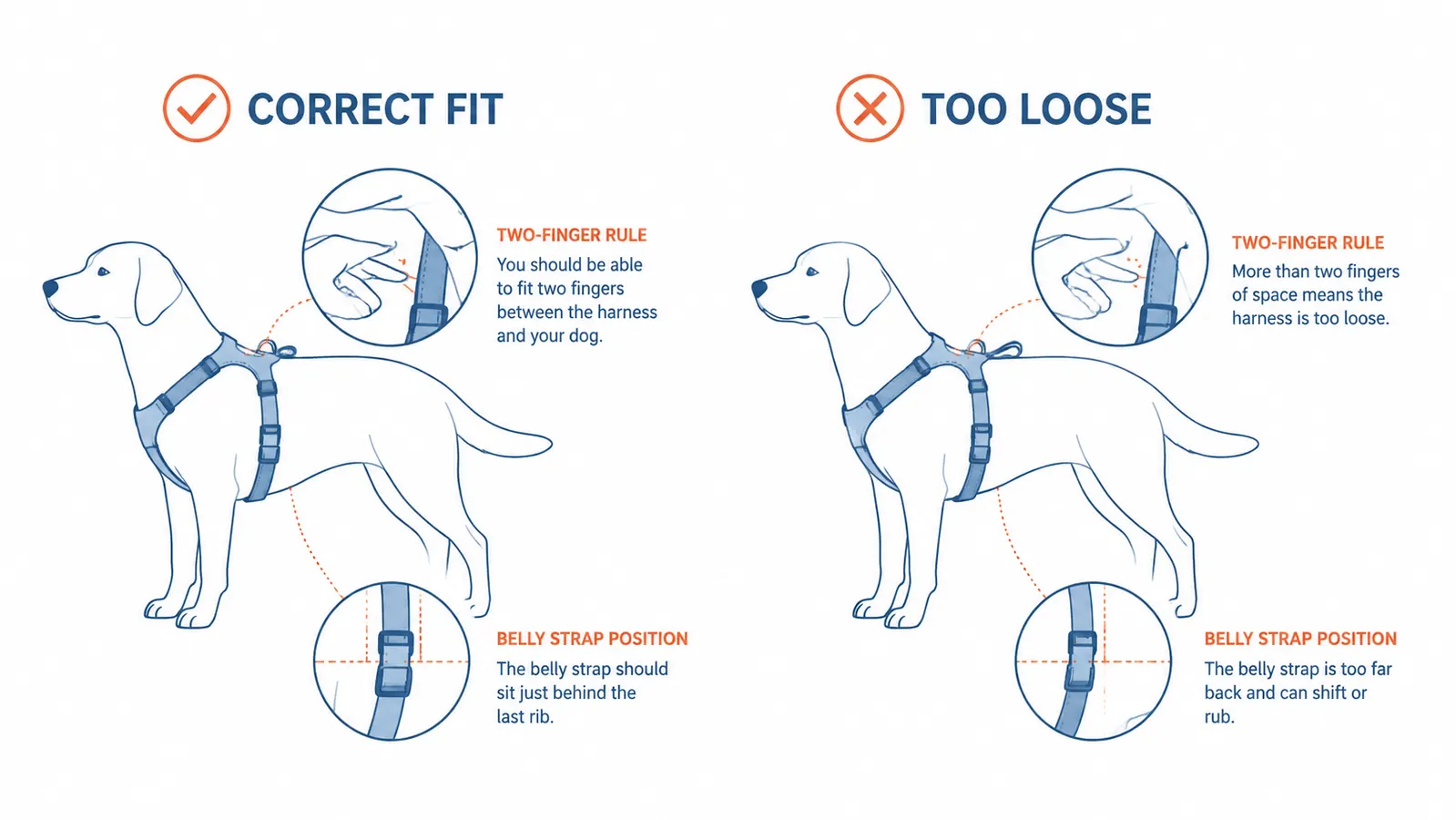
This is the one that most bothers me, because it is a safety issue and I have seen almost no one mention it in reviews. The side adjustment buckles on the Tru-Fit are the standard friction-style plastic clips found on most nylon harnesses. They are fine under normal conditions. The problem is that the motion of a dog sitting, standing, circling, and resettling in the back seat over a multi-hour drive puts repetitive micro-stress on those buckles in a direction that causes them to creep loose. Not dramatically loose. Not 'the harness is falling off' loose. But on Bear, after about 90 minutes of driving, I could reliably fit three fingers under the chest strap instead of the two-finger standard. That is enough looseness to change how the crash-load distributes. I now stop at every gas fill-up and do a 15-second snug check. That has solved the problem operationally. But it is a behavior I have to maintain, and I would not have guessed that from reading the product listing.
The fix, if this bothers you, is to run a small strip of hook-and-loop (velcro) over the buckle after you set it to lock the creep. Some dog-gear people sew a small keeper loop into the webbing. I went with the velcro approach and it works. But again: this is a workaround, not a feature.
The crash-test certificate tells you what happens in a controlled sled test. It does not tell you what happens to the fit on mile 200 of a Colorado highway drive.
What the Sizing Chart Gets Right and Where It Falls Apart
Kurgo's sizing instructions ask you to measure neck circumference and chest girth, and they tell you to use the larger measurement to pick your size. That is reasonable advice. The problem is that the harness fits as if chest girth is the only dimension that matters. There is no belly-girth measurement in the guide, and for dogs like Bear, that is the measurement that actually determines whether the lower strap fits comfortably or cuts in.
The sizes also run slightly generous. Bear's measurements are solidly Large per the chart, but a size XL might have fit him better given his barrel chest. There is no way to know this until the harness arrives. Kurgo's return policy is reasonable, so if the first size does not work, ordering a second one is not catastrophic. But I wish someone had told me to order one size up if my dog is broader through the ribs than the chart suggests.
The Escape Risk: When It Is a Real Concern
The Tru-Fit is not marketed as an escape-proof harness, and I want to be fair about that. No car harness is. But for dogs who are motivated back-out escapers, meaning dogs who have figured out that they can compress their chest and back out of a harness by pulling backward, the Tru-Fit's loosening-buckle issue compounds the risk in a specific and predictable way. If the chest strap has crept to three-finger loose, a determined escape artist has meaningful slack to work with.
Roux is not an escape artist, so this was never a live problem for us. But I know from the dog-travel community I am part of that some owners have had real issues with this, specifically with adolescent dogs who are still testing boundaries. If you have a dog who has back-pawed their way out of a collar, or who has worked out of a standard step-in harness, factor that into your decision. The Tru-Fit's design is not optimized against that behavior. The Sleepypod Clickit, which I cover in my Sleepypod Clickit comparison, has a different attachment geometry that is harder to defeat by backing out. Worth reading before you decide.
The Things That Genuinely Work Well
I want to be clear that I still use this harness. Bear wears it on every drive. The issues I described are real but they are not disqualifying for most dogs in most situations. Here is what I actually like, stated plainly.
The steel-reinforced seat belt loop is the best version of this component I have seen at this price point. Every cheaper harness I tried before this one had a nylon tether that frayed inside of six months. The Tru-Fit's metal loop shows no wear after 14 months. The front D-ring, while not the primary seat belt attachment point, is positioned well for leash work at rest stops and does not swing under the belly during a walk the way some front clips do. The webbing itself is thick enough to feel durable without being so rigid that it digs in when the dog is just lounging.
The buckle system is also faster to put on than most five-point harnesses. On a good day I can have Bear fully buckled and clipped in about 25 seconds. That matters at 6 a.m. in a truck stop parking lot when neither of us is at our best.
Pros
- Actual crash-test certification from the Center for Pet Safety, not self-reported
- Steel-reinforced seat belt loop shows real long-term durability
- Fast on/off buckle system, about 25 seconds once you know the harness
- Front D-ring works well for leash attachment at rest stops without flopping under the belly
- Webbing quality is noticeably better than comparably priced harnesses
- Fits long-bodied, lean dogs (hound types, lab mixes) exceptionally well
- Reasonable price given the certification level
Cons
- Belly strap placement causes chafing on deep-chested, short-torso breeds (retrievers, bulldogs, some spaniels)
- Side adjustment buckles creep loose on multi-hour drives; requires manual re-check stops
- Sizing chart does not account for belly girth, only chest; barrel-chested dogs may need to size up
- Dogs who back-out of harnesses can exploit the loosening buckle issue; not designed as escape-resistant
- Chest plate sits lower than marketing photos suggest on dogs with non-standard torso proportions
- No keeper loops on the webbing to hold excess strap tails, which flap at highway speed with the windows down
Who This Is For
The Tru-Fit is a strong choice for dog parents who want a genuine crash-test certification without paying the Sleepypod Clickit premium, and whose dog has a fairly standard build: long-bodied, medium to large, with a chest girth that maps cleanly to the size chart. Labs, vizslas, border collies, most mixed-breed dogs in the 40-70 pound range, and lean shepherds are the sweet spot. If your dog description matches Roux more than Bear, buy this with confidence.
I also think it is a solid choice for families with multiple dogs of different sizes, because Kurgo's sizing system is consistent enough that you can buy two or three sizes and have a reliable fit across a range of animals. We use a Medium for Roux and a Large for Bear and the adjustment logic is the same between them.
Who Should Skip It
If your dog is barrel-chested and short-torsoed, specifically golden retrievers, English setters, bulldogs, or any dog where the distance between the base of the neck and the last rib is shorter than you would expect for their weight, I would at minimum order one size up and be prepared to return it. Do not assume the chart measurement is the whole story. Measure your dog's belly girth at the widest point and compare it to the chest girth. If belly is close to chest, you are in standard territory. If belly is noticeably wider, you are Bear.
If your dog has a demonstrated history of backing out of harnesses or is in an active escape-testing phase, this is not the harness to trust without adding a secondary management strategy. A slip-proof belly band or a keeper clip on the seat belt tether will help, but I would rather be honest about the limitation than let you find out on I-25 that your dog is loose in the back seat.
If budget allows and these fit concerns feel too uncertain for your dog's specific build, I have a side-by-side breakdown of the Tru-Fit against the Sleepypod Clickit in my Sleepypod Clickit comparison. The Clickit costs significantly more but solves several of the issues I described here. Whether that tradeoff is worth it depends on your dog and how many miles a year you drive.
My Final Take After 14 Months
Bear still wears this harness. I have not replaced it. After my velcro buckle fix and after learning to do a quick snug check at every gas stop, the chafing is gone and the fit stays reliable enough for our trips. For the price and the crash-test certification, there is nothing else at this level that I would recommend more strongly to a dog parent with a standard-build dog. The honest version of that endorsement is: it is the best harness at this price point for the specific dog it fits well. The problem is that it does not fit all dogs well, and the marketing copy does not tell you which dogs those are.
If you read my longer six-month write-up, you will notice that article focuses on what held up over time. This one is intentionally about the friction, because the friction is what I wish someone had told me in month one instead of letting me discover it piecemeal. Buy it if your dog is Roux-shaped. Buy it with eyes open if your dog is Bear-shaped. Know your buckles will creep. Check them at every stop. Then trust the steel loop, because that part has never let me down.
Still the most affordable crash-tested option for dogs who fit it well.
The Kurgo Tru-Fit passes the Center for Pet Safety crash test and the steel seat-belt loop is built to last. If you have a standard-build dog and you are driving unsecured right now, this is a meaningful safety upgrade at a fair price. Check today's price and read the Q&A section on Amazon before ordering, it has useful real-world fit notes from owners.
Amazon Check Today's Price on Amazon →