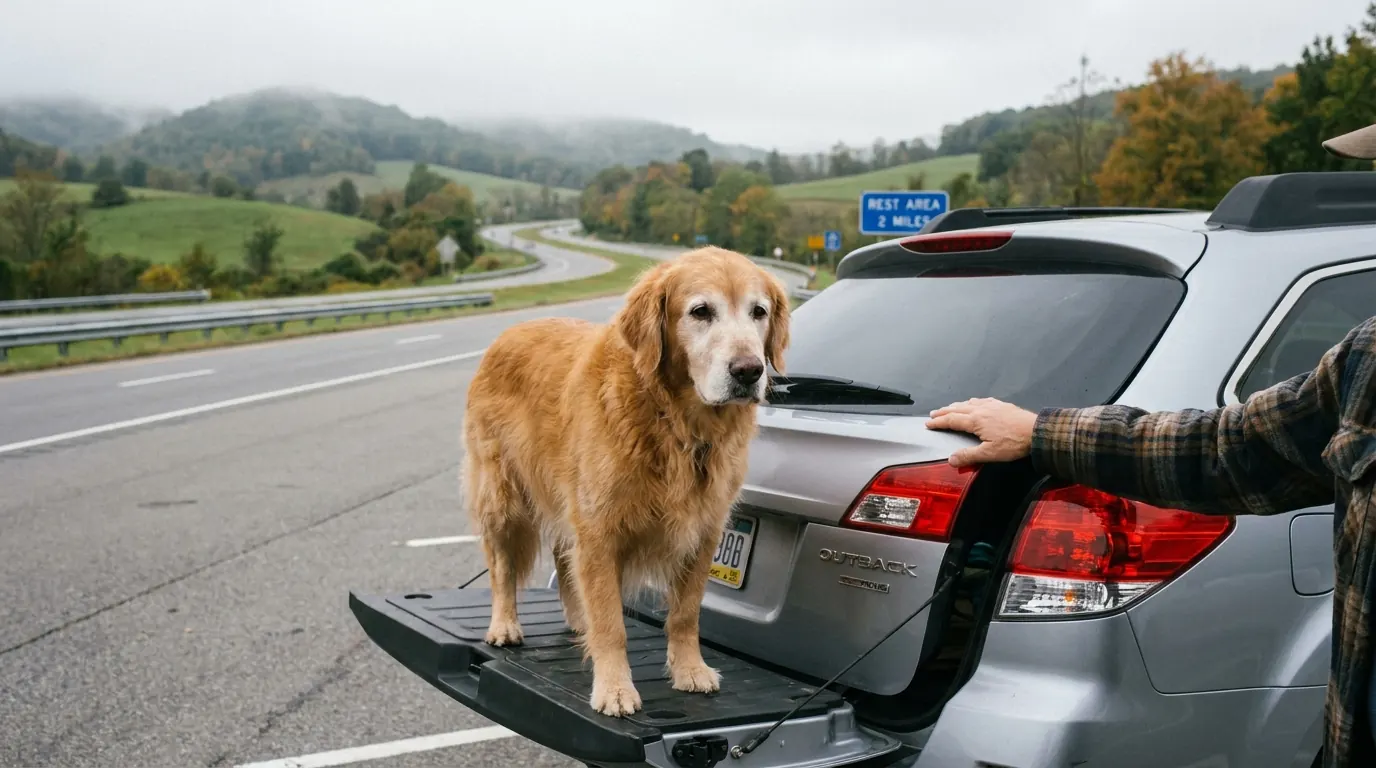
The moment I knew something had to change was at a rest stop on I-40 in New Mexico, somewhere between Albuquerque and Amarillo. We had been driving for about five hours, and when I opened the tailgate Bear just stood there. Not sniffing around, not doing his usual half-crouch-and-spring onto the cargo mat. He stood at the bumper, looked up at me, and waited. He is a 74-pound golden retriever who has been jumping into that truck since he was eight months old. That was the first time he asked for help.
He was eight at the time. His vet had mentioned joint supplements at his last annual, said the glucosamine category was well-studied and reasonable to start before you see obvious decline rather than after. I had nodded, said I would look into it, and then forgot about it for four months because he seemed fine at home. Long drives, though, are a different stress test than walking around the backyard. After the I-40 rest stop I came home, talked to his vet again, and started him on Nutramax Cosequin. That was eight months ago. Here is what I actually tracked.
Quick Verdict
Cosequin is a slow-working, vet-recommended joint supplement that genuinely improved Bear's post-drive stiffness and cargo-area confidence over three to four months of consistent daily use. It is not dramatic or fast. But eight months in, the difference on long travel days is real enough that I would not stop giving it to him.
Amazon Check Today's Price →Your senior dog should not have to struggle at the tailgate
Nutramax Cosequin is one of the most widely recommended glucosamine supplements in veterinary practice. It has over 78,000 Amazon reviews and a 4.7-star rating. If your older dog is showing early stiffness signs, this is worth a conversation with your vet.
Amazon Check Today's Price on Amazon →How I Have Used It (Eight Months, Daily)
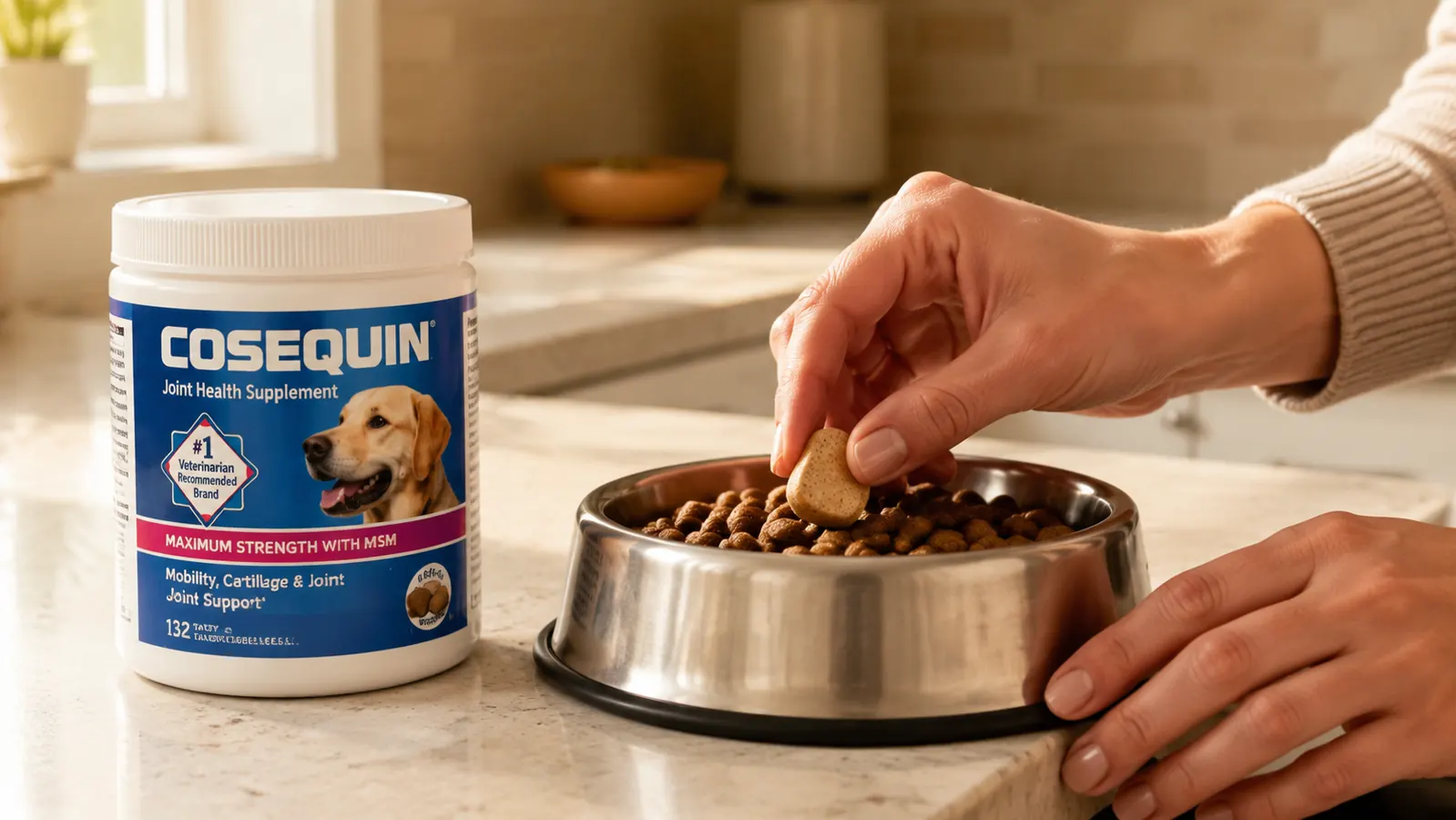
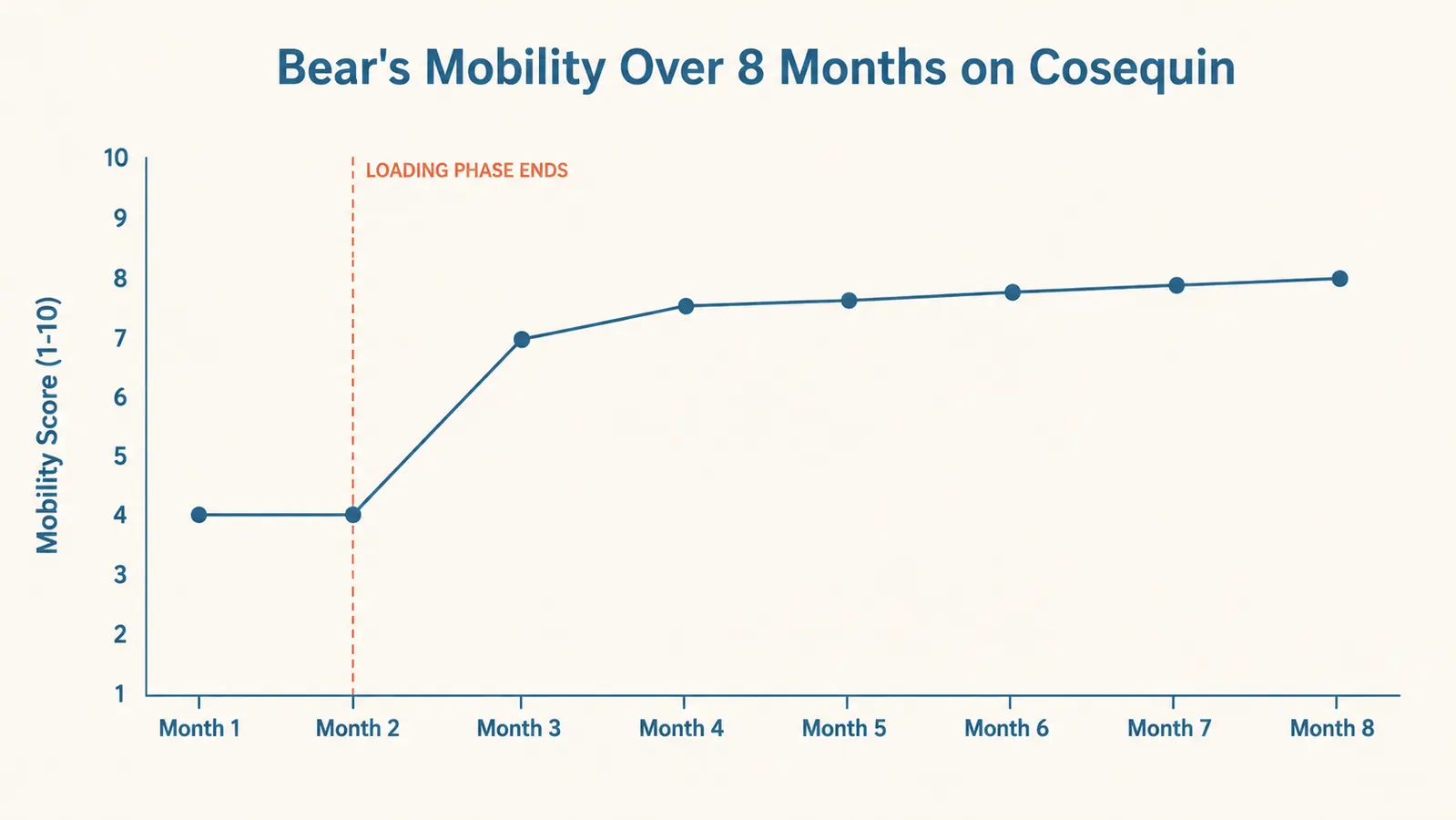
Bear gets one chewable tablet every morning, crumbled on top of his kibble. He weighs 74 pounds. The Cosequin DS (double strength) formula calls for two tablets per day during the loading phase, then one tablet for maintenance. I followed that exactly: two tablets for the first four to six weeks, then dropped to one. The tablets are small and have a mild, malty smell. Bear eats them without complaint. Roux, my border collie mix, is younger at four years old and does not take any joint supplement, so there is no cross-contamination confusion at feeding time.
We are on the road most weekends and take two or three longer trips per month, ranging from four to ten hours one way. Bear rides in the cargo area of my SUV on a hammock cover, with a non-slip mat underneath. I tracked his behavior at each rest stop: whether he initiated the jump out on his own, whether he needed a physical assist getting back in, and how long it took him to shake off the stiffness and walk normally once we were parked. I did not use any formal scoring tool. I kept notes in my phone. That is the extent of my methodology.
I also noted his morning routine at home the day after long drives. The morning-after stiffness was something I had started to think of as just Bear getting older. He would get up slowly, take a few stiff steps before loosening up, sometimes favor his left rear leg for a minute or two. That was the baseline I was working against.
What the First Six Weeks Looked Like (Spoiler: Not Much)
I want to be honest about this because I almost stopped before Cosequin had a chance to do anything. During the loading phase, I noticed nothing. Bear still needed help at the tailgate on drives over five hours. He still got up slowly the morning after a long day in the car. I kept giving him the supplement because I had committed to a 90-day trial and his vet told me plainly that glucosamine has to build up in joint tissue before you see any functional effect. She said six to eight weeks was the minimum window to expect anything.
Around week seven or eight, I noticed the first thing: the morning-after recovery was a little faster. He was still stiff when he got up, but he was shaking it off in about half the time. Instead of five or six slow steps before he moved normally, it was two or three. That is a small thing. But when you have been watching a dog for nine years, small changes read clearly.
Months Three Through Eight: The Changes I Actually Recorded
By month three the tailgate situation had improved noticeably. He was not back to his younger self, launching himself in without hesitation. But he was initiating the jump on his own about 70 percent of the time, compared to maybe 30 percent in the month before I started Cosequin. He would still ask for help on drives over seven or eight hours, particularly if we had done a lot of walking that day. I still have the step stool in the truck. I do not think I will ever take it out entirely.
The rest-stop behavior improved a lot. In the I-40 incident, he stood at the bumper and stared at me. By month four, he was doing the little bounce-and-hesitate I recognize as him deciding whether to try it, then trying it. By month six he was jumping in and out at most standard rest stops without hesitation, as long as the drive had been five hours or less. That is a meaningful difference when you are stopping every two hours anyway.
Curb climbing at rest stops also improved. There is always that one curb at a truck stop that is higher than it looks, and I had started pre-empting it by picking Bear up or steering him to a lower edge. By month five I noticed I had stopped doing that habitually. He was stepping up without the little stutter he had developed.
By month three the tailgate situation had improved noticeably. He was not back to his younger self, launching himself in without hesitation. But he was initiating the jump on his own about 70 percent of the time.
What the Vet Said at His Eight-Month Checkup
Bear had a routine checkup at month eight. I told his vet what I had observed and asked her to evaluate his joints. She noted his range of motion was good for his age and weight, said she did not see the early-stage stiffness response she sometimes sees in Labs his age, and told me to keep doing what I was doing. She did not say Cosequin was responsible for that. She said it was a reasonable contributing factor. That is about as strong an endorsement as you get from a careful veterinarian, and I will take it.
She also flagged that glucosamine supplements like Cosequin are in a NASC-quality-certified category, meaning the manufacturing standards are higher than generic store-brand supplements. Nutramax runs third-party quality testing, which is part of why this product has such a strong veterinary recommendation record. The formulation includes glucosamine hydrochloride and sodium chondroitin sulfate. Some Cosequin versions also include MSM. His vet said the HCl form of glucosamine has better bioavailability than glucosamine sulfate, which is what you find in a lot of cheaper options.
What Cosequin Did Not Fix
Bear still gets stiff on drives over eight hours. That is not a supplement failure; that is physics. A nine-year-old dog lying in one position in a moving vehicle for eight-plus hours is going to be stiff when he gets out, just like I am going to be stiff after the same ride. The supplement did not erase his age. It improved his baseline and his recovery, but I would be lying if I said he is moving like a five-year-old.
He also still favors his left rear on cold mornings. We are in the southwest mostly, so cold is relative, but when we camp in higher elevation in October and November, cold air at rest stops after dark still produces a visible hitch in his step for the first minute or two. Joint supplements work on the tissue. They do not override temperature.
And I will say this clearly: if your dog has a structural joint problem, a diagnosed injury, or significant arthritis, a glucosamine supplement is not going to replace veterinary treatment. Bear has early wear, not a diagnosed disease. Cosequin makes sense at that stage. It is a preventive and supportive tool, not a cure.
Pros
- Visible improvement in post-drive stiffness recovery by month two to three
- Noticeable increase in Bear's willingness to jump in and out of the SUV after month three
- NASC-quality certified and widely recommended by veterinarians
- Chewable tablet format is easy to administer with kibble
- Very affordable per-day cost compared to other joint supplements
- 78,000-plus Amazon reviews with a 4.7 average: not a fringe product
Cons
- No noticeable effect during the first six weeks; easy to quit too early
- Does not eliminate stiffness on very long drives or in cold temperatures
- Results are gradual and modest, not dramatic
- Two-tablet loading phase requires attention to dosing schedule
- You have to keep giving it consistently; it is not a one-and-done fix
How It Fits Into the Bigger Travel-With-a-Senior-Dog Picture
Cosequin is one piece of what I do to keep Bear comfortable on long drives. I also use a non-slip cargo mat so he is not bracing his joints against a slippery surface the whole trip, I stop every 90 to 120 minutes on drives over four hours, and I let him walk at a slow pace at rest stops rather than rushing him. If you are only doing one thing for a senior dog's joint health and you are a road-tripper, consistent supplementation plus regular movement breaks will do more than either one alone.
The step stool at the tailgate was the other big change. Even with Cosequin working, I do not ask Bear to jump up from full ground height into a raised cargo area on days when we have already driven six hours. That is just common sense. The supplement supports the joint; the step stool removes the impact load. Both matter. For more on managing rest-stop stiffness and post-drive recovery routines, my guide on helping a senior dog with joint stiffness after long drives covers the full before-during-after protocol I use with Bear.
Who This Is For
Cosequin is a strong option if your dog is seven or older and you are starting to notice early signs of joint stiffness: the slow-to-get-up mornings, the hesitation on stairs or at the vehicle door, the stiff first few steps after a long rest. It is especially worth considering if you travel with your dog regularly, because the extended static positions in a vehicle are harder on aging joints than regular daily movement. The sooner you start, the more preventive the benefit. Do not wait for your dog to ask for help at a rest stop bumper the way Bear did.
Who Should Skip It
If your dog has a diagnosed joint condition, moderate to severe arthritis, or has had orthopedic surgery, a basic glucosamine supplement is not the right starting point. That is a vet conversation about prescription-level NSAID management, physical therapy, and potentially a veterinary-grade supplement protocol with higher therapeutic doses. Cosequin is excellent for early-stage support and maintenance. It is not a treatment for significant disease. Also skip it if your dog is under five and showing no stiffness signs. There is no evidence that pre-loading a healthy young dog's joints does anything useful. Save the money for when the joints actually need support.
If you are curious how Cosequin stacks up against the other Nutramax option on the market, I compared both products in detail in my piece on Cosequin vs Dasuquin for senior dogs. Short version: same company, very different price tag, and whether the upgrade matters depends on where your dog is in their joint health timeline.
Eight months in, I would buy this again without hesitating
Cosequin is not exciting. There is no moment where you think wow, a supplement did that. But there are a hundred small moments over eight months where your senior dog jumps in the truck on his own, shakes off a rest stop without limping, and keeps up on the trail. That is worth the current price and the patience to get through the loading phase.
Amazon Check Today's Price on Amazon →